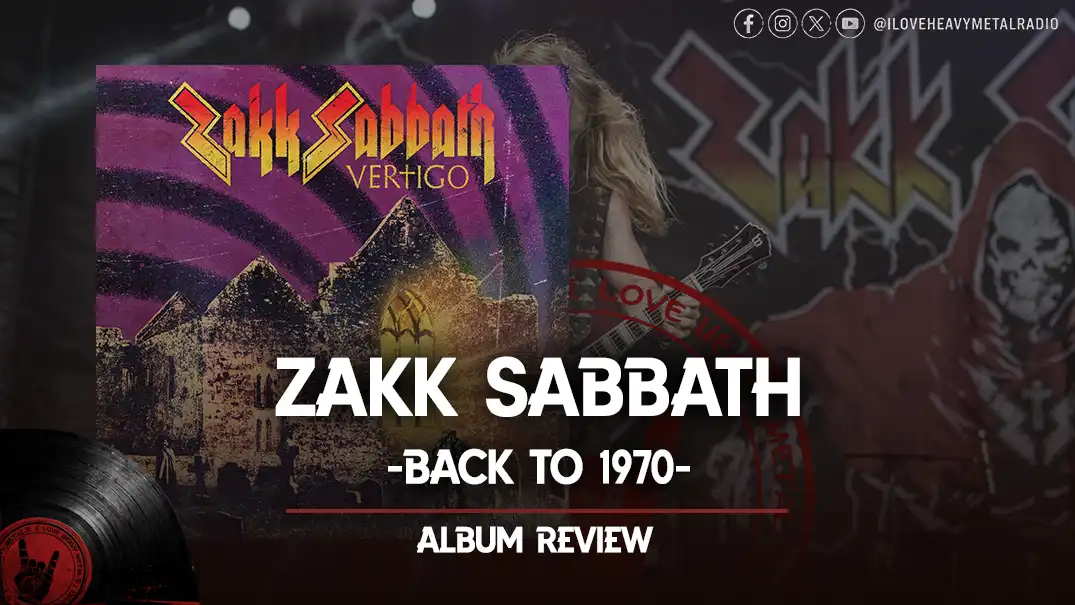

What happens when one of metal loudest modern guitar heroes goes back to where it all began?
You get Zakk Sabbath’s “Vertigo”! A crushing, note-for-note recreation of Black Sabbath legendary 1970 debut, played by three veterans who know exactly how much weight those riffs are supposed to carry.
This isn’t a remix. It isn’t a modern reimagining. And Zakk Wylde isn’t trying to rewrite Tony Iommi history.
He’s paying tribute to it – loudly.
Back to 1970
Released through Magnetic Eye Records “Vertigo” was created to celebrate the 50th anniversary of the album that helped give heavy metal its name and its sound.
The concept is beautifully simple: take Black Sabbath debut and play it as faithfully as possible.
And that’s exactly what Zakk Sabbath did.
The album follows the U.S. version of the original tracklist while also including “Warning”, the track that appeared on the original European/UK edition in place of “Wicked World”.
For fans who know every riff, drum fill and bass movement of the original, there are very few surprises here.
And that’s the point.
Zakk Wylde Meets Tony Iommi
Trying to play Tony Iommi riffs is one thing, trying to make them sound convincing is another.
Zakk Wylde takes on that enormous responsibility with a guitar tone that sounds like it was built to flatten a building. His playing brings a modern punch and enormous low-end weight, but he never loses the sinister character of Iommi original riffs.
The eerie tritones are still there. The slow, crawling doom is still there.
There’s just a hell of a lot of Zakk behind it.
Wylde also handles Ozzy Osbourne vocal parts, bringing his own rough-edged personality to songs that have been burned into the DNA of heavy metal for more than five decades.
No Computers. No Fixes. Just Three Guys Playing
This is where “Vertigo” gets particularly interesting.
Zakk Sabbath recorded the album live to 2-inch analog tape, deliberately avoiding digital editing and computer-assisted timing.
No Pro Tools coming to the rescue.
The band rehearsed extensively before entering the studio, allowing Zakk Wylde, Blasko and Joey Castillo to play the songs together in real time.
That approach makes sense when you’re recreating an album recorded in the very early days of heavy metal.
The original Black Sabbath debut was famously recorded extremely quickly, essentially capturing a young band playing live in the studio.
Zakk Sabbath wanted that feeling back.
And you can hear it.
The Rhythm Section Has a Job From Hell
While Wylde naturally gets most of the attention “Vertigo” wouldn’t work without the rhythm section.
Rob “Blasko” Nicholson takes on Geezer Butler bass lines, which are far more adventurous than they sometimes get credit for. Butler wasn’t simply following Iommi’s guitar, his bass often wandered, pushed and interacted with Bill Ward drumming.
Blasko captures that movement while locking tightly with Joey Castillo.
And Castillo had perhaps the most difficult job of all.
Bill Ward drumming on the original album wasn’t simply heavy. It swung.
There was jazz in it. There was looseness. There were fills that sounded like they were happening in the moment.
Castillo recreates that spirit without turning the songs into overly polished modern metal performances.
The result is a power trio that sounds like it’s actually playing together rather than assembling a recording one digitally perfect piece at a time.
The Riffs Still Hit Like a Ton of Bricks
More than 50 years later, the opening of “Black Sabbath” still sounds like something crawling out of the ground.
That tritone riff, the rain, the bells. Ozzy voice.
It’s difficult to imagine heavy metal without it.
On “Vertigo” Zakk Sabbath turns that familiar darkness into something even more physically massive.
“The Wizard” keeps its swagger and bluesy character, while “Wasp/Behind the Wall of Sleep/Basically/N.I.B.” reminds you just how strange and inventive the original Sabbath could be.
Then there’s “Iron Man” one of the most recognizable riffs in metal history.
And somehow, after all these years, it still works.
That’s the real test of a tribute like this. When you already know every note, can the performance still make you want to turn the volume up?
With “Vertigo”, the answer is yes.
Faithful — Maybe Too Faithful?
Here’s where the critics have a legitimate point.
“Vertigo” doesn’t reinvent Black Sabbath.
It doesn’t take “Paranoid” and turn it into a thrash song. It doesn’t transform “N.I.B.” into a modern metal anthem. It doesn’t throw unexpected arrangements at the listener.
It’s almost obsessively faithful.
For some listeners, that makes the album feel unnecessary. If you already own Black Sabbath debut, why do you need another band playing the exact same songs?
But that’s also what makes the project work.
Zakk Sabbath aren’t pretending to be the next Black Sabbath.
They’re fans.
And there’s something refreshing about a tribute where the musicians aren’t desperately trying to put their own stamp on every second of the music.
Sometimes the highest form of respect is simply saying:
“This was perfect. Let’s play it again.”
Why Is It Called Vertigo?
The title is a nod to Vertigo Records, the legendary label that released Black Sabbath debut in the UK in 1970.
It’s another small detail that shows what this project is really about.
“Vertigo” isn’t just a cover album.
It’s a piece of heavy metal history recreated by musicians who clearly understand the importance of the source material.
The Physical-Only Experiment
Wylde also wanted the project to feel like an object from another era.
Rather than treating “Vertigo” as another album destined for the endless streaming pile, Zakk Sabbath kept the release away from major streaming platforms.
The idea was to make the record feel tangible, something you actually own.
For a project built around recreating a 1970 recording experience, that decision fits perfectly.
Put the physical record on.
Turn the volume up.
And for the next 40 minutes or so, pretend it’s 1970.
The Story Didn’t End Here
The experiment clearly worked well enough for Zakk Sabbath to do it again.
In 2024, the band released “Doomed Forever, Forever Doomed”, taking the same concept and applying it to Black Sabbath next two landmark albums: “Paranoid” and “Master of Reality”.
That makes “Vertigo” the beginning of something bigger, a celebration of the early Sabbath catalog through the ears, hands and amps of some seriously experienced metal musicians.
Final Verdict
Is “Vertigo” essential if you already own Black Sabbath debut?
Probably not.
Is it fun as hell?
Absolutely.
The biggest compliment you can give Zakk Sabbath is that they understood what not to change.
The monstrous riffs remain monstrous. The strange atmosphere remains strange. The groove remains loose and human. And Zakk Wylde enormous guitar sound gives these 1970 songs enough modern muscle to hit like a ton of bricks.
It’s not Black Sabbath.
Nothing could be.
But that’s never what “Vertigo” was trying to be.
It’s three veteran metal musicians standing in front of one of the genre’s sacred texts and saying, “We fucking love this album”.
And honestly?
You can hear it in every riff.
For fans of Black Sabbath, Zakk Wylde, doom and the history of heavy metal, “Vertigo” is one hell of a tribute. 🤘

 By
By
 By
By