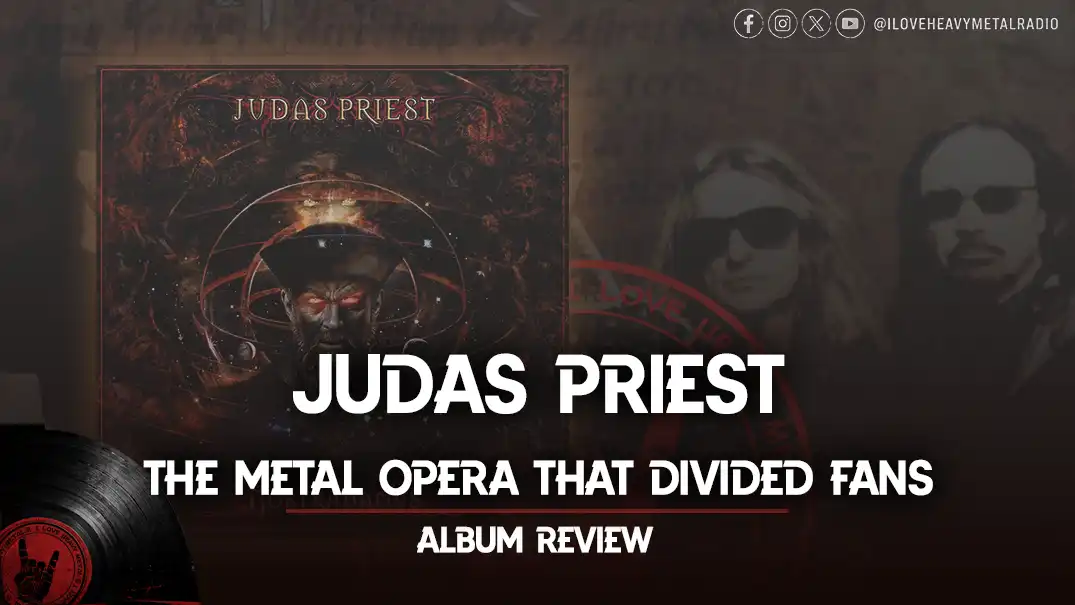

Judas Priest had already conquered heavy metal. So in 2008, instead of playing it safe, the Metal Gods decided to do something nobody quite expected: they made a nearly two-hour metal opera about a 16th-century prophet.
The result was “Nostradamus”.
Released as a double album “Nostradamus” tells the story of Michel de Nostredame, better known as Nostradamus, the French mystic whose famous prophecies have fascinated people for centuries.
It was ambitious, theatrical and unapologetically over the top.
It was also one of the most divisive albums Judas Priest ever made.
For some fans “Nostradamus” is an underrated masterpiece that showed Priest were still willing to take risks. For others the album enormous length, instrumental passages and heavy use of keyboards and orchestration made it a difficult listen.
Almost 20 years later, metalheads are still arguing about it.
Judas Priest Decided to Break Their Own Formula
By 2008 Judas Priest didn’t need to prove anything.
This was the band that had given metal “British Steel”, “Screaming for Vengeance”, “Defenders of the Faith” and “Painkiller”. Their formula was legendary: crushing riffs, twin guitars, pounding drums and Rob Halford unmistakable voice cutting through the noise.
“Nostradamus” deliberately stepped away from that formula.
The guitars were still important, but suddenly there were choirs, sweeping synthesizers, orchestral arrangements, atmospheric passages and dramatic instrumental sections surrounding them.
Even Halford approached some of the material differently, using a more theatrical and operatic vocal style that suited the concept.
This wasn’t Judas Priest trying to sound like Judas Priest from 1980.
This was Judas Priest trying something completely different.

“Prophecy” Sets the Tone
The album begins with “Prophecy” and Priest waste little time explaining what kind of journey they’ve planned.
Sharp riffs and driving double-bass drums provide the metal foundation, while the symphonic elements immediately push the song into darker and more dramatic territory.
It feels grand from the opening moments.
Then comes “Revelations” one of the album major epics. Running for around seven minutes, the track slowly builds its atmosphere before Halford delivers one of his more theatrical performances.
It’s the kind of song that makes more sense when you stop treating “Nostradamus” like a collection of individual singles and start thinking of it as one long production.
When Priest Gets Heavy Again
For listeners who need a little more traditional metal firepower “Persecution” is an obvious highlight.
The song brings a faster, more aggressive attack and some of the vocal intensity associated with Halford work outside Priest, particularly his Fight era.
It’s one of those moments where the album suddenly reminds you:
Yes, these are still Judas Priest.
“Visions” takes a completely different approach. Slower and more melodic, it has one of the album more accessible structures and a memorable hook.
It is also a good example of why dismissing “Nostradamus” as nothing but keyboards and orchestration doesn’t really work.
There are plenty of different shades hiding inside the album.
The Title Track Goes Full Metal Opera
The title track “Nostradamus” is where the album concept reaches one of its biggest theatrical moments.
Massive choral arrangements, dramatic vocals and an almost cinematic atmosphere make the song feel larger than a conventional heavy metal track.
And that’s exactly what Priest were chasing.
“Nostradamus” isn’t simply an album with a historical character at its center. It tries to build an entire musical world around him.
Sometimes it works brilliantly.
Sometimes it feels like Priest forgot that metalheads have lives to get back to.
The Problem: Nearly Two Hours Is a Long Time
This is where the debate surrounding “Nostradamus” really begins.
The album is ambitious but ambition can become excess.
With a running time approaching two hours “Nostradamus” demands considerably more patience than most Judas Priest records. The atmospheric passages and instrumental interludes can add to the cinematic experience, but they can also make the album feel repetitive or stretched out.
For listeners expecting another “Painkiller” this was a serious adjustment.
Some critics and fans have argued that the concept would have been much stronger as a shorter single album, with the weaker or more repetitive sections removed.
And honestly, that’s probably the biggest obstacle to loving “Nostradamus”.
There is great material here.
There is just a lot of it.

But That’s Also Why Some Fans Love It
The other side of the argument is equally interesting.
Some metal fans appreciate “Nostradamus” precisely because Priest refused to make the obvious record.
Instead of another collection of traditional heavy metal anthems, the band created something cinematic, progressive and theatrical.
For those listeners “Nostradamus” works best as a complete experience rather than a playlist of individual songs.
Put the headphones on. Start the album. Let it run.
Don’t skip the atmospheric sections just because they aren’t immediately throwing a guitar riff at your face.
Approached that way, the album starts to feel less like a failed attempt at classic Priest and more like what it actually was: a massive experiment from a band that had nothing left to prove.
So, Is Nostradamus a Good Judas Priest Album?
The honest answer depends on what you want from Judas Priest.
If you want the raw speed and aggression of “Painkiller”, “Nostradamus” can feel frustrating.
If you want the classic songwriting and immediate hooks of “British Steel”, you’ll probably find yourself missing the simplicity.
But if you appreciate progressive, symphonic and theatrical metal, there is something genuinely fascinating about watching Judas Priest throw themselves completely into an idea this ambitious.
“Nostradamus” isn’t perfect. It is too long.
Some sections could have been trimmed.
And yes, there are moments when the keyboards and orchestration threaten to overwhelm the riffs.
But calling it boring or pointless misses what makes the record interesting.
Judas Priest took one of the biggest risks of their later career and they did it at a point when they absolutely didn’t have to.
The Verdict
“Nostradamus” is not Judas Priest easiest album.
It isn’t their fastest. It isn’t their most accessible.
And it certainly isn’t the album to play when you’re looking for another “Painkiller”.
But it is one of their most ambitious. That’s why the debate continues.
Nearly two decades after its release “Nostradamus” remains the Priest album that can turn a room full of metalheads into a heated discussion: bold masterpiece or overblown metal opera?
Maybe the truth sits somewhere in the middle.
Either way, Judas Priest deserves credit for taking the risk.
Five tracks to start with
⚔️ “Prophecy” – The perfect introduction to the album darker symphonic sound.
⚔️ “Revelations” – A seven-minute theatrical epic with a huge atmosphere.
⚔️ “Persecution” – One of the album heavier and more aggressive moments.
⚔️ “Visions” – Slower, melodic and instantly more accessible.
⚔️ “Nostradamus” – The massive title track that showcases the album full theatrical ambition.
So grab the headphones, turn the lights down and give “Nostradamus” the one thing it demands more than anything else:
time.
Judas Priest
Rob Halford – vocals
Glenn Tipton – guitars, guitar synthesizer
K. K. Downing – guitars, guitar synthesizer
Ian Hill – bass guitar
Scott Travis – drums

 By
By
 By
By