
Before Viking metal had a name, Bathory were already heading there.
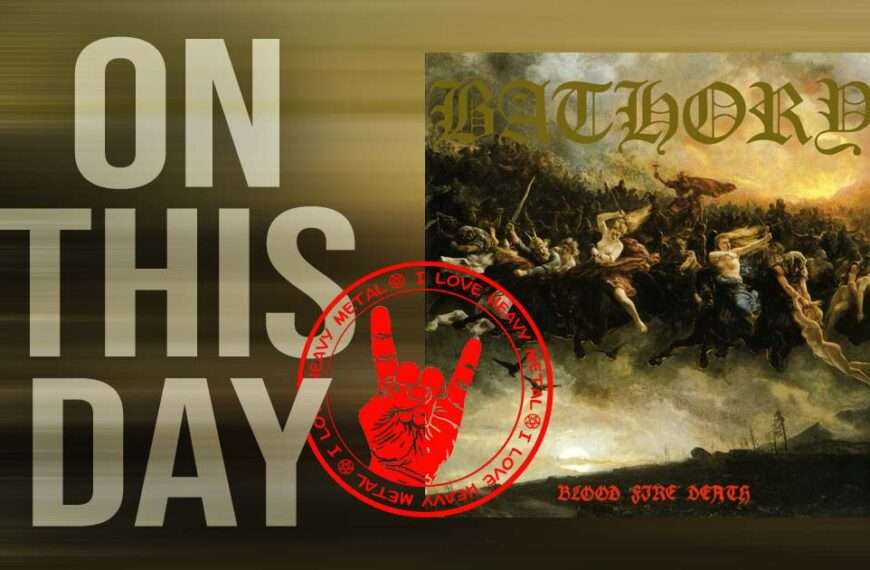
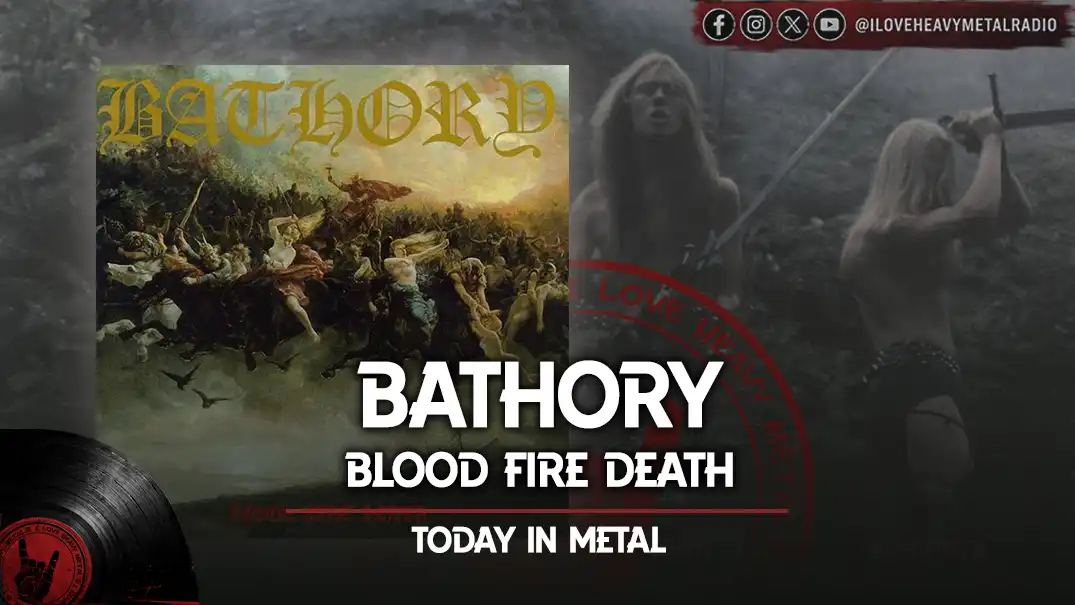
On October 8th, 1988, the Swedish band released “Blood Fire Death” their fourth studio album, a record that still carried the darkness and aggression of their black metal years, but suddenly felt much bigger.
The Satanic imagery was fading.
The Norse mythology was taking over.
And Bathory were about to open the door to a completely different era.
From Black Metal to Viking Metal
“Blood Fire Death” is still largely a black metal album, but something had changed.
The raw attack of Bathory first three records began giving way to epic arrangements, acoustic passages and Norse-inspired atmosphere. Quorthon was moving toward what he described as the “pre-Christian Swedish Viking Era.”
The full transformation would come with “Hammerheart”, but “Blood Fire Death” was the turning point.
This is where the foundations were being laid.
The opening track, “Odens Ride Over Nordland” immediately announces that something different is happening. The Wild Hunt imagery, the atmosphere and the combination of acoustic and electric sounds give the album a sense of scale that goes far beyond the band earlier work.
It doesn’t just sound darker. It sounds ancient.
The Wild Hunt
The album legendary cover comes from Norwegian Romantic artist Peter Nicolai Arbo’s 1872 painting The Wild Hunt of Odin.
Bathory used a section of the painting for the cover, while “Odens Ride Over Nordland” also draws on the Wild Hunt motif from folklore.
That combination became hugely influential in metal culture.
The image of Odin riding through the night matched the music perfectly and helped establish a visual language that countless bands would later explore.
Quorthon wasn’t simply writing songs about Norse mythology. He was creating an entire atmosphere around it.
Satan Was Still Hiding in the Lyrics
Even though “Blood Fire Death” contains no explicitly Satanic lyrics, Quorthon hadn’t completely abandoned the band earlier darkness.
There were secrets hidden in the words.
The first letters of the lines in “The Golden Walls of Heaven” form the word SATAN.
“Dies Irae” also contains an acrostic with an anti-Christian message.
So while Bathory were looking toward Odin, Viking-era Sweden and Norse folklore, the old Bathory was still lurking underneath.
You just had to know where to look.
Borrowed Words, Ancient Stories
Quorthon songwriting also reached into literature.
The lyrics to “For All Those Who Died” were taken from a poem by Erica Jong, first published in her 1981 book Witches.
Meanwhile, the first three verses of “A Fine Day to Die” were adapted from Cassilda’s Song in Robert W. Chambers’ The King in Yellow.
That song would become one of the album defining moments and decades later, its reputation had grown far beyond the underground.
In 2023, Rolling Stone placed “A Fine Day to Die” at No. 76 on its list of the greatest metal songs of all time.
The Mystery of Kothaar and Vvornth
“Blood Fire Death” also introduced another Bathory tradition.
The album featured anonymous session musicians credited under the pseudonyms Kothaar and Vvornth.
Kothaar was credited with bass, while Vvornth handled drums. Quorthon remained at the center of everything, handling guitars, vocals, percussion, effects, production, engineering and mixing.
The anonymous identities only added to the mythology surrounding Bathory.
Nothing about the band needed to feel completely real.
It was supposed to feel like a legend.
The Album Quorthon Loved
There is an interesting detail that makes “Blood Fire Death” even more important: Quorthon frequently cited it as his personal favorite among the Bathory albums he created.
That says something about where he believed the band was heading.
The album was still violent and raw enough to satisfy the old Bathory spirit, but it was also reaching toward something more epic, atmospheric and uniquely Swedish.
The result was a record that stood between two worlds.
Black metal on one side.
Viking metal on the other.
And Bathory were standing right in the middle.
“Blood Fire Death” didn’t completely abandon the past.
It transformed it.
Black metal classic or the moment Bathory truly became legendary?


 By
By
 By
By
 By
By