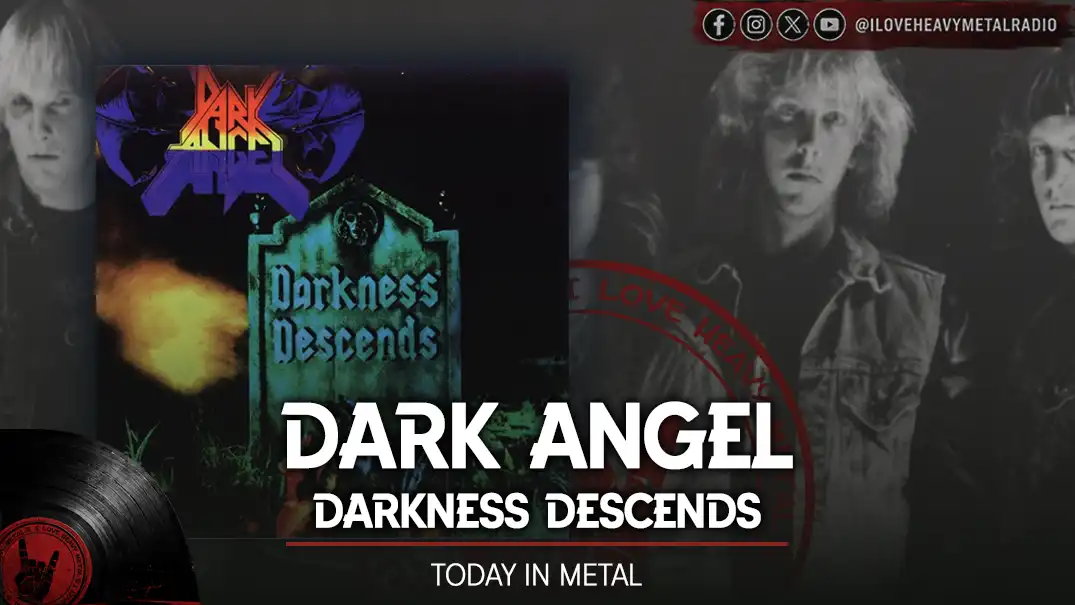

There are albums that sound perfect. There are albums that sound raw. And then there are albums that hit you so hard that you don’t really care about their imperfections.
Dark Angel’s “Darkness Descends” belongs in that last category.
Released on November 17, 1986, this second studio album became one of the most respected records in extreme thrash metal. It’s fast, aggressive, technical and absolutely relentless. But there’s something interesting about this record that makes its story even better.
Gene Hoglan, the drummer behind all that madness, isn’t exactly its biggest fan when it comes to listening back to his own performance.
In fact, he has admitted that the album is difficult for him to listen to today.
So how did a record that its own drummer criticizes become such an important part of thrash metal history?
Let’s go back to 1986.
November 17, 1986 – Seven Tracks of Pure Aggression
By 1986, thrash metal was moving at full speed. Metallica had “Master of Puppets”, Megadeth had “Peace Sells… But Who’s Buying?” and Slayer had just released “Reign in Blood”.
And then there was Dark Angel.
Coming out of Downey, California, and earning the reputation as “The L.A. Caffeine Machine” for their hyper-speed live shows, the band had already released their debut album, “We Have Arrived”, in 1985. But “Darkness Descends” was a different beast.
Produced and engineered by Randy Burns, who also worked on Megadeth’s “Peace Sells… But Who’s Buying?” that same year, the album featured vocalist Don Doty, guitarists Jim Durkin and Eric Meyer, bassist Rob Yahn and a new drummer who would eventually become one of the most recognizable names in metal drumming: Gene Hoglan.
Seven tracks. Around 35 minutes. No unnecessary breaks.
From the opening title track to “Perish in Flames”, the album barely gives you time to catch your breath.
“Merciless Death”, “The Burning of Sodom” and “Black Prophecies” are among the tracks that helped establish the album’s reputation.
This wasn’t music designed to make everyone happy. It was aggressive, fast and unapologetically extreme.
Gene Hoglan Was Only 18
Here’s something that makes the album even more impressive.
Gene Hoglan was just 18 years old when he recorded “Darkness Descends”.
It was also his first time working extensively in a professional recording studio. He had plenty of energy and confidence, but he was still learning how to turn that energy into a proper studio performance.
Looking back years later in an interview with Revolver, Hoglan was surprisingly honest about his playing.
He described himself as not being tight enough and admitted that the guitar sound wasn’t particularly great either.
He also revealed something many listeners might not expect.
Dark Angel actually played much faster live than they did on the album. They deliberately slowed things down during recording because Hoglan believed the band needed to feel the music rather than simply play as fast as possible.
Imagine that.
A record famous for its speed was actually a slower version of what Dark Angel were doing on stage!
The Drummer Isn’t Happy With His Own Masterpiece
Most musicians look back at their classic albums with pride. And while Hoglan appreciates the reputation “Darkness Descends” has earned, his feelings are a little different.
He has explained that the record is difficult for him to listen to because he knows what he could have done better.
His comments are interesting because they show just how much his approach to drumming changed over the years.
We know Gene Hoglan today as a drummer with incredible precision, stamina and technical ability. His work with Death, Testament and Strapping Young Lad has made him a respected name across several generations of metal fans.
But on “Darkness Descends”, we hear a young musician still developing his style.
And perhaps that’s part of the charm.
The record isn’t polished into something comfortable. It has that youthful aggression and hunger that can be difficult to recreate once musicians become more experienced.
Sometimes the mistakes and rough edges are part of what makes an album special.
Released After Slayer’s “Reign in Blood”
There’s another reason why 1986 was a difficult year for Dark Angel.
Slayer had released “Reign in Blood” just over a month earlier, on October 7, 1986.
That’s a pretty difficult album to follow!
Gene Hoglan later recalled that some listeners immediately compared Dark Angel to Slayer, even calling them “Slayer babies”.
He also joked that if “Darkness Descends” had arrived in August or September instead of November, perhaps people would have received it differently.
The timing certainly didn’t help.
But was Dark Angel really just another Slayer copy?
Listen to the album and make up your own mind.
There are similarities in the speed, aggression and overall attitude, but Dark Angel had their own approach. The guitar work, complicated arrangements and Hoglan’s drumming gave the album a character of its own.
And looking back now, it deserves to be discussed as more than a record that arrived after “Reign in Blood”.
Seven Tracks That Still Hit Hard
Forty years later, “Darkness Descends” remains a record that deserves to be played loud.
The title track is a brutal opening statement. “The Burning of Sodom” brings the speed, while “Merciless Death” is exactly the kind of track that reminds you why old-school thrash fans love this album.
And then there’s “Black Prophecies”, an eight-minute monster that gives the band room to show a more complex side.
The album closes with “Perish in Flames”, leaving very little doubt about the band’s intentions.
It’s also worth mentioning that Hoglan didn’t just play drums, he immediately became the band’s main lyricist, writing nearly all of the album’s lyrics, including penning “The Burning of Sodom” while he was still attending high school.
Eighteen years old, writing lyrics like that and recording an album that would remain part of thrash metal history for four decades.
Not a bad start!
A Thrash Classic Doesn’t Have to Be Perfect
This is what makes “Darkness Descends” such an interesting album to revisit.
Its drummer has openly criticized parts of the recording. The guitar sound wasn’t what he wanted, and the band had actually slowed down for the studio.
Yet fans continue to celebrate it.
Maybe that’s the point. Not every classic needs perfect production or a technically flawless performance. Sometimes an album captures something that cannot be measured with studio equipment.
The anger, the energy, the hunger and the feeling that the musicians are pushing themselves as far as they can go.
Dark Angel captured all of that in 1986.
And forty years later, “Darkness Descends” still has plenty of life left in it.
Now we want to hear from you!
Do you agree with Gene Hoglan’s criticism of his own performance, or do you think the rawness of “Darkness Descends” is exactly what makes it great?
And where would you rank it among the greatest thrash metal albums of 1986?

 By


 By