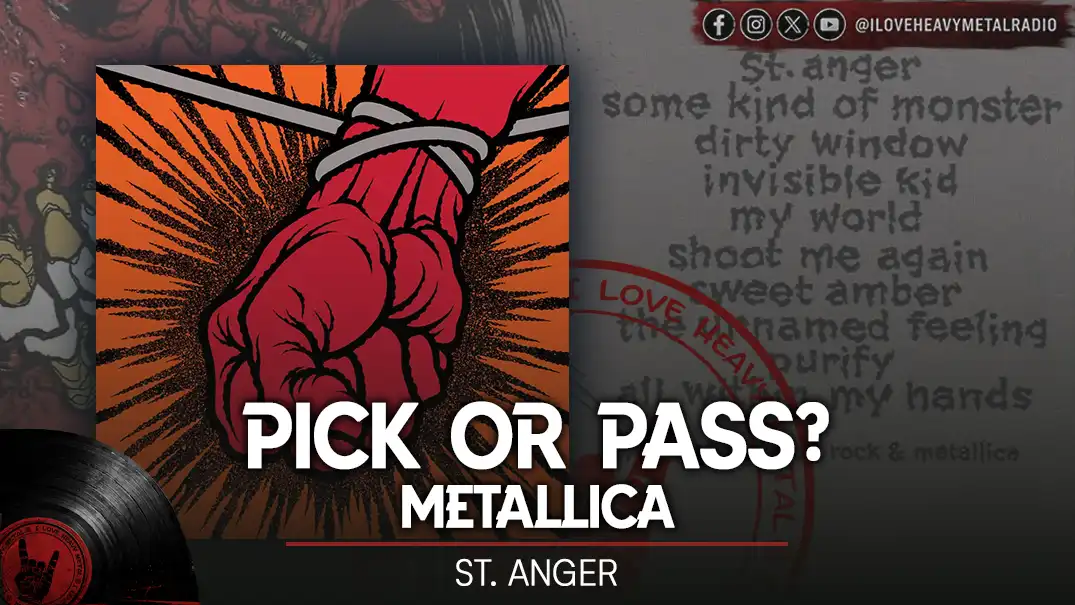

Some Metallica fans would rather forget this album ever happened. Others will tell you that “St. Anger” deserves more respect than it gets. And then there are those who still can’t get past that snare drum.
Released in 2003, “St. Anger” became one of the most controversial albums in Metallica’s career. It sounded different, looked different and arrived at a time when the band was going through some serious personal and internal struggles, chaotic sessions that included James Hetfield entering rehab, the band working with a performance coach and cameras capturing the whole turbulent process for the 2004 documentary “Some Kind of Monster”.
Following Jason Newsted’s departure in 2001, longtime producer Bob Rock even stepped in to play bass on the studio recordings, as Robert Trujillo joined just before the album hit shelves.
No guitar solos. Strange drum sounds. Long songs. Raw production. And a whole lot of anger.
But was it really that bad? Or did Metallica simply make an album that many fans weren’t ready to accept?
Let’s put it under the microscope.
The Good: There Is Something Interesting Here
Let’s get one thing straight: “St. Anger” isn’t a boring album because it lacks ideas. If anything, it has plenty of them.
The band went for a rawer, dirtier and more aggressive sound. The polished production of the previous albums was gone, replaced by something rough around the edges.
And that aggression works in places.
“Frantic” is a strong opener. It comes in with restless energy and doesn’t waste much time getting going. The title track has a heavy, almost hypnotic groove and even went on to win the 2004 Grammy Award for Best Metal Performance, while “Some Kind of Monster” has moments that really stick with you.
There is also something quite personal about this record. James Hetfield was dealing with his own struggles and the album carries plenty of frustration, pain and anger. It doesn’t always come out in the most elegant way, but you can hear that the band wasn’t trying to make another comfortable Metallica record.
And perhaps that’s one of its biggest strengths.
They took a risk. They didn’t simply repeat the formula that had already worked for them.
The Bad: That Snare Drum…
Now, let’s talk about the elephant in the room. Lars Ulrich’s snare drum.
You know exactly what we’re talking about.
By leaving the snare wires turned off during recording, Ulrich created that metallic, almost trash-can ring that became the album’s most famous feature, and not necessarily for the right reasons.
For some listeners, it gives “St. Anger” a unique and aggressive character. For others, it’s an incredibly distracting sound that makes the entire album difficult to enjoy.
And the snare isn’t the only problem.
The songs often go on longer than they need to. Some riffs feel repetitive, and the arrangements could have used more variation. The lack of guitar solos was another big talking point, especially for fans who grew up loving Kirk Hammett’s lead work.
There are moments when the album feels like a collection of ideas that needed another round of editing.
Eleven songs and around 75 minutes is a lot when so many sections sound similar.
Raw and aggressive? Absolutely.
But raw doesn’t automatically mean great.
What Did the Critics Think?
Interestingly, the critical reaction wasn’t entirely negative.
According to Metacritic, “St. Anger” has a score of 65 out of 100, based on 20 critic reviews. Thirteen reviews were positive, two mixed and five negative.
Some critics appreciated the aggression and the band’s willingness to take a different direction. Others weren’t impressed with the production, repetitive songwriting and unusual drum sound.
Pitchfork gave the album a particularly harsh review, while Spin and NME were among the publications that responded much more positively.
So even when it first arrived, “St. Anger” wasn’t universally rejected.
It was divisive from the beginning.
Why Do Some Metallica Fans Defend It?
Here’s where things get interesting.
Not everyone listens to “St. Anger” expecting another “Master of Puppets” or “…And Justice for All”.
Some fans appreciate it precisely because it sounds so different.
They hear an angry, frustrated band trying to find its way through a difficult period. They enjoy the rough guitar sound, the heavy grooves and the emotional honesty.
And let’s not forget that songs like “Frantic”, “St. Anger” and “All Within My Hands” have found their own audience.
Maybe the album works better when you stop comparing it to Metallica’s classics.
But that’s easier said than done when the band behind it is Metallica.
Our Verdict: PICK or PASS?
Let’s be honest. “St. Anger” is not Metallica’s finest hour.
The production is questionable, the snare sound is difficult to ignore, and several songs could have benefited from tighter arrangements.
But calling the entire album a disaster feels too easy.
There is genuine aggression here, some memorable riffs and an emotional side that makes the record stand apart from the rest of their discography.
It isn’t an album we would recommend to someone discovering Metallica for the first time. But for longtime fans who are willing to approach it with an open mind, there is something worth hearing.
Our verdict: PICK – but with reservations.
It’s flawed, frustrating and sometimes downright strange. But at least it dared to be different.
And perhaps that’s better than playing it safe.
Your Turn: Pick or Pass?
Now we want to hear from you.
Is “St. Anger” one of Metallica’s most misunderstood albums or is its bad reputation completely deserved?
Would you keep it in your collection, or would you rather pretend it never happened?
PICK or PASS? Let us know in the comments.



 By