
Some albums arrive sounding perfect. Others arrive carrying scars.
Queensrÿche’s “The Warning” is one of those records where the music is so damn good that you can’t help wondering how much greater it could have been with the production the band actually wanted.
Released on September 7th, 1984, “The Warning” was the debut full-length from a young Seattle band that clearly had bigger ambitions than simply becoming another 80s metal act. Recorded in London with producer James Guthrie, the album reached No. 61 on the Billboard 200 and introduced a band already reaching toward progressive metal, science fiction, political paranoia and cinematic storytelling.
But there was a problem.
The band reportedly went massively over budget during recording, and EMI ultimately took control of the project. The finished album was mixed by Val Garay, a producer without a heavy metal background.
Queensrÿche hated the result. And honestly, you can hear why.
A Great Album Wearing the Wrong Jacket
The production on “The Warning” is probably its biggest weakness.
Compared with the sharper guitar attack of the band self-titled EP, the album sounds flatter and more cavernous. Some of the intricate work happening underneath the guitars gets buried beneath that unmistakable early-80s studio sheen.
For a band whose entire identity depended on precision, atmosphere and guitar interplay, it wasn’t an ideal situation.
But here’s the thing:
The songs are too good to be killed by the mix.
Listen past the production and there’s an incredibly ambitious young band throwing everything they have into these tracks.
This isn’t ordinary 1984 radio metal. It’s something stranger.
Between Maiden and Pink Floyd
Queensrÿche understood heavy metal, but they were clearly looking beyond it.
“The Warning” sits somewhere between the galloping attack of New Wave of British Heavy Metal, the atmospheric ambition of Pink Floyd and the progressive complexity of Rush.
That combination became one of the band greatest strengths.
You get twin-guitar harmonies, dramatic vocals, changing time signatures and traditional metal riffs, but there’s also a feeling that these songs are building toward something larger.
The band wasn’t interested in simply writing another three-minute fist-pumping anthem.
They were building worlds.
“Warning”
The title track immediately shows the band traditional metal side.
Driving riffs, twin guitars and Geoff Tate soaring voice create an aggressive opener that still sounds hungry decades later.
Michael Wilton was heavily involved in the song creation, bringing the kind of galloping guitar attack that connected Queensrÿche to the NWOBHM bands that influenced them.
But even here, the band sounds more sophisticated than most of their contemporaries.
The riffs don’t simply repeat. They move.
“NM 156” – The Machine Takes Over
Then Queensrÿche gets weird.
“NM 156” is one of the album defining tracks and one of the clearest signs of where the band was heading.
The song deals with technology, machines and human dependence on artificial intelligence, wrapped in an unsettling rhythmic structure that feels almost mechanical.
Scott Rockenfield drumming is crucial here.
Rather than simply sitting on a standard 4/4 beat, he uses unusual rhythmic patterns, fills and spacing that make the song feel unstable.
The music sounds like a machine malfunctioning. And that’s exactly what makes it work.
It’s an early glimpse of the dystopian storytelling Queensrÿche would later take to another level on “Operation: Mindcrime”.
“Take Hold of the Flame”
If “The Warning” has one song that demanded attention, it’s “Take Hold of the Flame”.
This is Queensrÿche at their most anthemic.
The melody is huge. Tate sounds completely in control. And Chris DeGarmo guitar work gives the song its unmistakable identity.
It became a particularly massive hit for the band in Japan, where it helped establish Queensrÿche as an international act despite relatively modest commercial success at home.
It’s also one of those songs that proves progressive metal doesn’t have to sacrifice a chorus.
You can have complicated musicianship and still write something that thousands of people want to scream along with.
“Roads to Madness”
And then Queensrÿche decided to end the album with a nearly ten-minute epic.
Because apparently being a young metal band in 1984 wasn’t ambitious enough.
“Roads to Madness” is the album grand finale, bringing together heavy guitars, orchestration, progressive arrangements and one of Geoff Tate most dramatic vocal performances.
The orchestral arrangements were conducted and arranged by Michael Kamen, who would later become famous for scoring films including Die Hard and Lethal Weapon.
Kamen would eventually work with Queensrÿche again, arranging the strings for their massive 1990 hit “Silent Lucidity”.
But “Roads to Madness” already showed that the band understood the power of combining metal with cinematic music.
It’s sprawling, emotional and completely unapologetic.
The Orwell Shadow
The album themes weren’t pulled from nowhere.
Queensrÿche were writing this material while touring behind their debut EP, and the political paranoia of the early 1980s found its way into the music.
George Orwell’s “Nineteen Eighty-Four” was a major influence, particularly in the album dystopian atmosphere and themes surrounding technology and control.
“NM 156” is the obvious example, but that sense of paranoia runs through the record.
The young Queensrÿche weren’t just looking at the world around them.
They were asking where it was going.
Considering what the band would eventually create with “Operation: Mindcrime” that early fascination with dystopian storytelling suddenly looks very important.
Five Musicians With Something to Prove
The classic Queensrÿche lineup was already frighteningly talented.
Geoff Tate – Lead Vocals & Co-Lyricist
Tate brought an extraordinary, theatrical vocal range to the band. His soaring delivery became one of the defining sounds of early progressive metal with “Roads to Madness” standing as one of his most impressive performances.
He was also central to the album lyrical direction, helping shape its dystopian and socio-political themes.
Chris DeGarmo – Guitars & Backing Vocals
DeGarmo was one of the band principal musical architects and a major songwriter behind the album.
His writing helped Queensrÿche move beyond straightforward heavy metal, while his work on “Take Hold of the Flame” produced one of the band signature songs.
Michael Wilton – Guitars & Backing Vocals
Wilton supplied the heavier traditional metal foundation, working alongside DeGarmo to create Queensrÿche distinctive twin-guitar sound.
Their approach wasn’t about endless 80s shredding.
It was about harmony, structure and melody.
Scott Rockenfield – Drums & Percussion
Only 21 when the album was released, Rockenfield was already showing an unusually adventurous approach to drumming.
His complex rhythms and unusual fills helped give songs like “NM 156” their tense, mechanical character.
Eddie Jackson – Bass & Backing Vocals
Jackson provided the low-end foundation while adding melodic movement underneath the guitars.
His bass work and the band layered backing vocals helped create the dense musical architecture that became one of Queensrÿche signatures.
The Twin-Guitar Secret
One of the coolest things about “The Warning” is how much thought went into the guitar arrangements.
DeGarmo and Wilton didn’t simply play the same riff together.
They built counter-melodies and harmonized guitar parts, creating dense layers that rewarded repeated listening.
Tracks such as “En Force” and “Before the Storm” show just how much detail was hiding inside the songs.
It’s the kind of guitar work that doesn’t necessarily scream for attention.
But remove one part and suddenly the whole thing feels different.
From Opening for Titans to Building Their Own Empire
After the album release, Queensrÿche embarked on an extensive tour between August 1984 and July 1985.
For a young band still establishing itself, the support slots were ridiculous.
They opened for KISS during the Animalize tour and for Iron Maiden during the legendary World Slavery tour in the United States.
In Europe, they shared stages with Dio and Accept.
Imagine being a young Queensrÿche member in 1984, walking onto a stage after watching those bands from the side of the stage.
That’s one hell of a metal education.
The Cover Has a Story Too
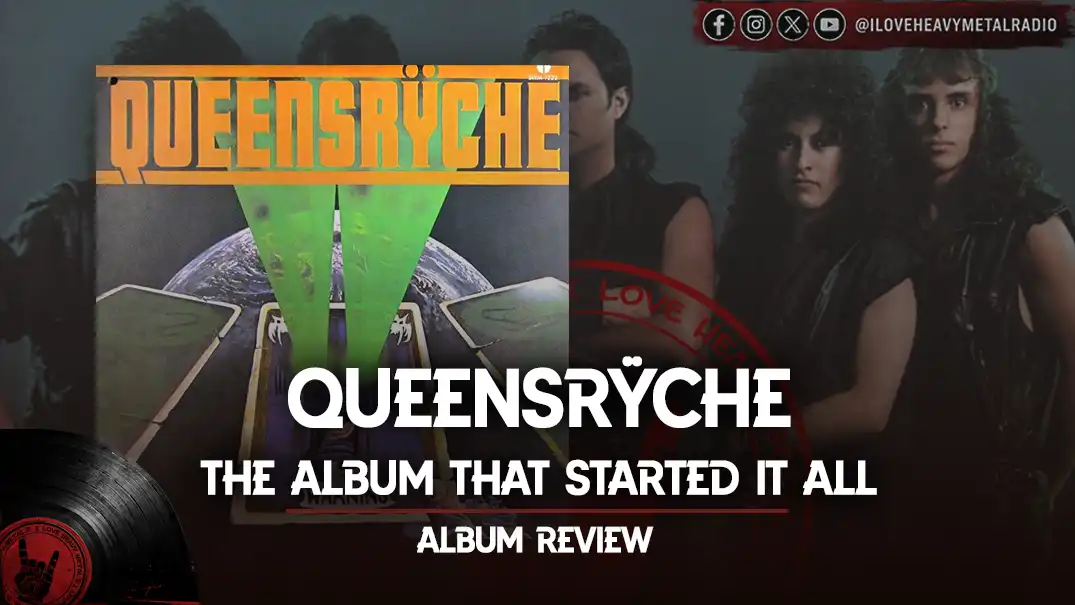
The album artwork features three tarot-like cards spread beneath glowing green laser beams, with a mysterious hooded figure appearing in the imagery.
It perfectly matches the album mixture of science fiction, mysticism and paranoia.
And there’s an amusing historical detail hiding in the physical release itself.
The original jacket credits James Guthrie as producer but specifically identifies Val Garay as the mixer.
It’s almost a tiny physical reminder of the creative battle surrounding the album.
The Flawed Classic
It’s easy to imagine “The Warning” sounding better.
That’s probably the frustrating part.
The musicianship is incredible. The songwriting is ambitious. Tate is phenomenal. The guitar work is sophisticated. Rockenfield drumming is adventurous.
But the production doesn’t always allow those details to hit with the force they deserve.
And yet, decades later, the album remains important because of what it represents.
This was a young band already refusing to stay inside the boundaries of traditional 80s heavy metal.
They wanted atmosphere. They wanted stories. They wanted complicated arrangements. They wanted metal that could make you think.
And they were only getting started.
Final Verdict
“The Warning” isn’t Queensrÿche most polished album.
It isn’t as streamlined as “Empire”, and it doesn’t have the fully realized conceptual precision of “Operation: Mindcrime”.
But judging it only against what came later misses the point.
In 1984, this was an ambitious debut from a hungry young band trying to build something bigger than the scene around them.
The production may have dulled some of the edges, but it couldn’t hide the talent.
Behind that flat mix is an album full of great riffs, ambitious songwriting, progressive arrangements, soaring vocals and the unmistakable feeling that Queensrÿche were heading somewhere special.
8/10 – A flawed sonic mix cannot diminish a landmark early progressive metal album.
And if you want to understand where Queensrÿche later masterpieces came from, “The Warning” is where you start.
Turn it up.
Listen past the production.
“The Warning” was already there. 🤘

 By
By