
What if a knight went to war believing he was fighting for God, only to discover that the real battle was happening inside his own soul?
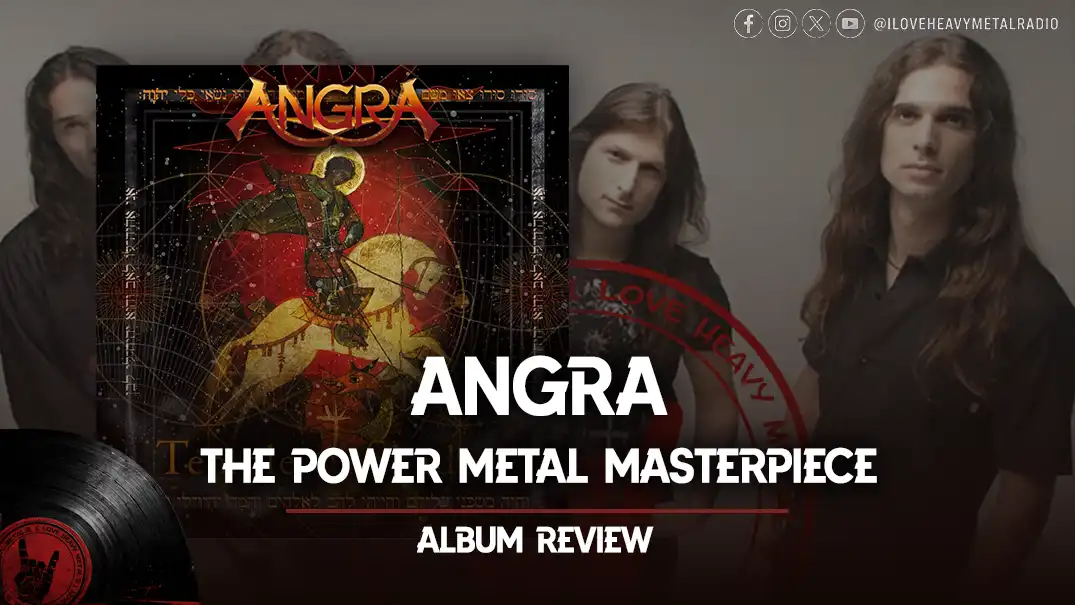
That question sits at the heart of Angra’s “Temple of Shadows”.
Released on September 6th, 2004, the Brazilian progressive/power metal band fifth studio album was far more than another collection of soaring vocals, lightning-fast guitars and massive choruses. It was an ambitious concept album about war, faith, doubt, violence and spirituality and somehow, Angra managed to make all of it sound ridiculously good.
A Crusader’s Journey Into Darkness
The story, written by guitarist Rafael Bittencourt, follows the fictional “Shadow Hunter” an 11th-century Crusader who joins the First Crusade.
He starts his journey convinced that he is fighting for a righteous cause.
Then reality hits.
Violence, death and loss slowly begin destroying his certainty. The more he witnesses, the more he questions the holy war, the Catholic Church and eventually the very meaning of spirituality.
This isn’t a simple good versus evil story.
It’s about what happens when someone discovers that the beliefs they were willing to die for aren’t as clear as they once seemed.
The Shadow Hunter may be fictional, but his crisis of faith feels painfully human.
“Deus Le Volt!” — God Wills It
The album opens with “Deus Le Volt!” an orchestral introduction whose title references the famous Crusader battle cry Deus vult – “God wills it” – associated with the First Crusade.
It’s a perfect beginning.
Before the guitars even arrive, Angra makes it clear that this isn’t going to be a standard power metal adventure about glorious heroes and epic battles.
Something darker is coming.
And when the guitars finally explode into action, the album reveals its secret weapon: Angra can deliver all the speed and precision expected from power metal while constantly pushing beyond its boundaries.
Power Metal With a Brazilian Soul
This is where “Temple of Shadows” separates itself from the crowd.
Angra never sounded like a band simply copying the European power metal formula. Brazilian rhythms, acoustic guitars, orchestration and unexpected melodic ideas are woven naturally into the songs.
The musicianship is extraordinary, but the technical playing never becomes the point for its own sake.
That’s important.
You can admire the ridiculous guitar work and complicated arrangements, but you can also walk away humming the melodies.
That’s the difference between impressive musicianship and great songwriting.
The Shadow Hunter
One of the album most memorable moments is “The Shadow Hunter”.
The song begins with an extended acoustic, flamenco-inspired guitar passage before eventually exploding into Angra heavier sound.
It’s a perfect musical representation of the protagonist journey.
And it’s classic Angra: take something unexpected, throw it into a metal song and somehow make it feel completely natural.
An All-Star Guest List
“Temple of Shadows” also features an impressive collection of guest musicians.
Kai Hansen, the legendary guitarist of Gamma Ray and former Helloween member, appears on “The Temple of Hate”.
Hansi Kürsch of Blind Guardian lends his unmistakable voice to “Winds of Destination”.
Brazilian musical legend Milton Nascimento appears on “Late Redemption” bringing a completely different vocal character to the record.
And Sabine Edelsbacher of Edenbridge contributes vocals to “Spread Your Fire” and “No Pain for the Dead”.
These aren’t famous names thrown onto the credits for decoration.
Each guest adds another color to an album that already refuses to stay inside one musical box.
“The Temple of Hate”
With Kai Hansen involved, expectations were naturally high.
“The Temple of Hate” delivers the speed, aggression and riff power that power metal fans came for. But within the album story, the song represents something darker.
The Shadow Hunter is beginning to see what lies behind the machinery of holy war.
The title says plenty.
The faith that once gave him purpose is beginning to turn into something he fears.
“Winds of Destination”
Then comes “Winds of Destination” featuring Hansi Kürsch.
The Blind Guardian connection feels almost inevitable. Kürsch dramatic voice fits beautifully into Angra expansive songwriting, while the song itself captures the enormous scale of the protagonist journey.
It’s cinematic power metal, but never forgets that the riff comes first.
“Late Redemption”
One of the album biggest surprises arrives with “Late Redemption”.
Milton Nascimento gives the track a deeply Brazilian character and creates one of the record most emotional moments.
It’s another reminder that Angra never treated their heritage as something to hide.
They brought it into the metal.
And “Temple of Shadows” is stronger because of it.
“Gate XIII” — The Ending Is a Puzzle
The final track contains one of the album coolest details.
“Gate XIII” is an orchestral instrumental that acts almost like a musical summary of everything that came before.
It incorporates motifs and melodies from earlier songs, turning the album into one interconnected piece.
Within the story, it represents the protagonist life flashing before his eyes as he reaches the end of his journey.
It’s the kind of detail that rewards anyone who listens to the album from beginning to end.
And that’s exactly how “Temple of Shadows” should be heard.
Not shuffled.
Not as background noise.
As a journey.
The Rebirth After Rebirth
The album was also an important moment in Angra own story.
Following the departure of original vocalist Andre Matos and other founding-era members, the new lineup had already introduced itself on “Rebirth”.
“Temple of Shadows” was the second album featuring Edu Falaschi, Aquiles Priester and Felipe Andreoli, alongside founding guitarists Kiko Loureiro and Rafael Bittencourt.
This time, there was no question whether the new Angra could survive.
They weren’t simply surviving.
They were becoming something formidable in their own right.
The Lineup That Delivered the Classic
The musicians on “Temple of Shadows” were a technical powerhouse.
Edu Falaschi – Lead Vocals
Falaschi delivers the soaring melodies and dramatic intensity needed to carry such a massive story.
Kiko Loureiro – Lead & Rhythm Guitars
Loureiro precise and melodic guitar work is one of the album defining features, balancing technical fireworks with memorable hooks.
Rafael Bittencourt – Lead & Rhythm Guitars
The principal concept writer and one of the album key musical architects, Bittencourt helped shape both the story and sound.
Felipe Andreoli – Bass
Andreoli provides the muscular and highly technical low end that keeps the complicated arrangements moving.
Aquiles Priester – Drums & Percussion
Priester powerful, highly technical drumming adds enormous energy to the album progressive side.
Together, they created one of the strongest and most technically gifted eras in Angra history.
A Power Metal Masterpiece?
There’s a reason “Temple of Shadows” continues to appear on lists of essential power metal albums.
It has speed, it has melody, it has progressive complexity, it has symphonic grandeur, it has Brazilian identity.
And, most importantly, it has songs.
That’s what keeps a technically impressive album from becoming a musicians-only exercise.
You don’t need to understand every time signature or guitar passage to feel its impact.
You just need to press play.
More Than Two Decades Later, It Still Feels Huge
The most impressive thing about “Temple of Shadows” is how ambitious it was without losing its emotional center.
This could easily have become an overly complicated concept album buried beneath orchestration, technical guitar work and historical references.
Instead, Angra created something remarkably cohesive.
The story gives the music purpose. The music gives the story emotion.
And the Brazilian influences give the entire record an identity that separates it from the endless sea of European-style power metal.
More than two decades after its release “Temple of Shadows” still sounds like a band taking a huge risk and getting almost everything right.
It’s dramatic without being cheesy.
Technical without becoming soulless.
Heavy without abandoning melody.
And ambitious without ever forgetting the riff.
Angra didn’t just build a temple of shadows. They built one of the great progressive power metal albums of its era.
Now it’s your turn:
Is “Temple of Shadows” Angra ultimate masterpiece — or does another album wear the crown? 🤘🔥


 By
By