
Boy from Serbia, a girl from Bosnia, city torn apart by war and an old cellist who keeps playing while the world around him falls to pieces.
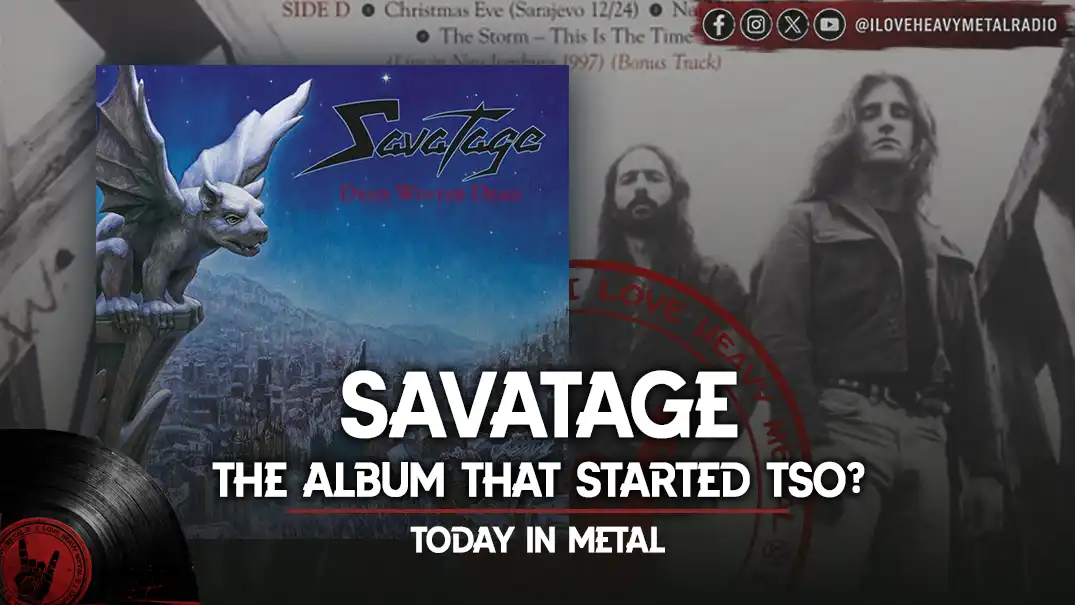
That is the heart of “Dead Winter Dead” the ninth studio album by American heavy metal band Savatage, released on October 24, 1995. Instead of writing another collection of guitar driven metal songs, Jon Oliva and producer Paul O’Neill built a concept album around the Bosnian War and the people caught in its violence.
The result was one of the most important turning points in Savatage’s history. It gave the band a new musical direction, brought an unexpected instrumental to mainstream radio, and helped set the stage for Trans-Siberian Orchestra.
But the story behind “Dead Winter Dead” is about much more than a hit song.
A Love Story in the Middle of a War
Set during the Bosnian War, the album takes place in Sarajevo. It tells the story of a Serbian boy named Serdjan and a Bosnian girl named Katrina, brought together in a city divided by war.
At the centre of the story is an old man playing his cello among the ruins. While people struggle to survive and mortars explode around him, he continues to play classical music.
The character was inspired by Vedran Smailović, the real-life cellist who became known for playing in war damaged Sarajevo.
Savatage took that inspiration and made it part of a tragic rock opera. In the album’s story, the cellist is killed by a shell on Christmas Eve, bringing the two young lovers together. The real Smailović survived the war, but his courage and music gave the band a powerful starting point.
It is a heavy story, but not simply because of the violence. “Dead Winter Dead” looks at what happens when people are divided by nationality and religion, and how humanity can still find a way through the hatred.
The cello ends up standing for that resistance. Bombs and bullets can destroy cities, but music can still cross the lines to reach people.
Savatage Put Down the Guitars and Picked Up the Piano
After the death of founding guitarist Criss Oliva, Savatage entered a difficult period. With “Dead Winter Dead”, Jon Oliva and Paul O’Neill took the band songwriting in a different direction.
Much of the material was composed on piano rather than guitar. That decision helped shape the album’s more theatrical sound, making orchestral music a huge part of the metal sound.
This wasn’t Savatage abandoning its roots. The guitars were still there, but they were now part of a much larger musical picture.
The album features Zachary Stevens on lead vocals, with Jon Oliva returning to share lead vocal duties after stepping away from that role on “Edge of Thorns” and “Handful of Rain”. Oliva sings on “I Am” taking on the voice of war and greed, and “Doesn’t Matter Anyway” where he plays a cynical arms dealer.
That second song’s rapid-fire lyrics were so difficult to deliver that Oliva later admitted it was nearly impossible to perform live.
The lineup also brought together guitarists Al Pitrelli and Chris Caffery, bassist Johnny Lee Middleton, and drummer Jeff Plate. Caffery returned as an official guitarist for the first time since “Gutter Ballet”, while “Dead Winter Dead” marked Plate’s first studio album with Savatage.
It was a new chapter for the band, both musically and in terms of its lineup.
Mozart, Beethoven and Heavy Metal
Classical music wasn’t just an extra layer added to the album. It was part of its foundation.
“Memory” includes a quotation from Beethoven’s Ninth Symphony, while “Mozart and Madness” builds a heavy metal passage around Mozart’s Symphony No. 25. Al Pitrelli also brings the complex classical guitar solo for “Mozart and Madness” in a single studio take.
Then there is “Christmas Eve (Sarajevo 12/24)” an instrumental medley of the traditional carols “Carol of the Bells” and “God Rest Ye Merry Gentlemen”.
By mixing classical strings with electric guitars, the song sounds fresh yet totally familiar. They might be playing holiday tunes, but there is nothing light or fluffy about Savatage’s heavy style.
And the music fits the story. In a city surrounded by destruction, the sound of Christmas carols becomes something more than a seasonal celebration. It becomes a reminder of what war threatens to take away.
The Song That Changed Everything
Here is where the story of “Dead Winter Dead” takes an unexpected turn.
“Christmas Eve (Sarajevo 12/24)” broke out as a radio hit in the United States. An instrumental combining traditional Christmas music with heavy metal had found an audience far beyond the band’s usual listeners.
Paul O’Neill and Jon Oliva saw the possibilities. If this mix of classical music, holiday melodies, and rock could connect with so many people, why not build something bigger around it?
That idea helped lead to the creation of Trans-Siberian Orchestra.
TSO released the same track on its 1996 debut album, “Christmas Eve and Other Stories”. What began as part of a Savatage concept album became the starting point for a separate project that would go on to reach a much wider audience.
It’s an unusual legacy for a song born from a story about war. A piece written around the suffering of people in Sarajevo helped create a new musical tradition for listeners around the world.
Savatage didn’t simply record a Christmas instrumental. They helped open a door to something that would grow far beyond this album.
The Gargoyle That Could Only Watch
The album cover tells its own story. Painted by artist Edgar Jerins, the gargoyle looks down with stone eyes watching the suffering below.
Gargoyles are usually built on churches to protect them. Here, that idea turns dark. The gargoyle is supposed to stand guard but it is completely helpless against the violence in the streets below.
It can only watch.
That image fits “Dead Winter Dead” perfectly. The album is filled with people facing events they cannot control, caught between fear, hatred, and the hope that something better might still be possible.
The cover really drives home the main point: what good is a protector if it can’t actually protect anyone?
A Different Kind of Savatage Classic
Released on October 24, 1995, “Dead Winter Dead” pushed Savatage beyond the traditional heavy metal album format. Its story, classical influences and piano led writing gave the band a new identity, while its biggest instrumental track helped inspire Trans-Siberian Orchestra.
“Christmas Eve (Sarajevo 12/24)” was a huge hit, but it shouldn’t outshine the rest of the album. This project tells a bigger story about war, division and how people try to find hope when their world is collapsing.
Savatage does an amazing job mixing heavy metal, classical music and a sad human story. The music is huge and dramatic, but the main point is simple: Even in the worst times, people can still find a way to connect.
What is your favourite part of “Dead Winter Dead”, the full rock opera or the unforgettable “Christmas Eve (Sarajevo 12/24)”? And do you consider this a Savatage classic in its own right, beyond its connection to TSO?

 By
 By
 By