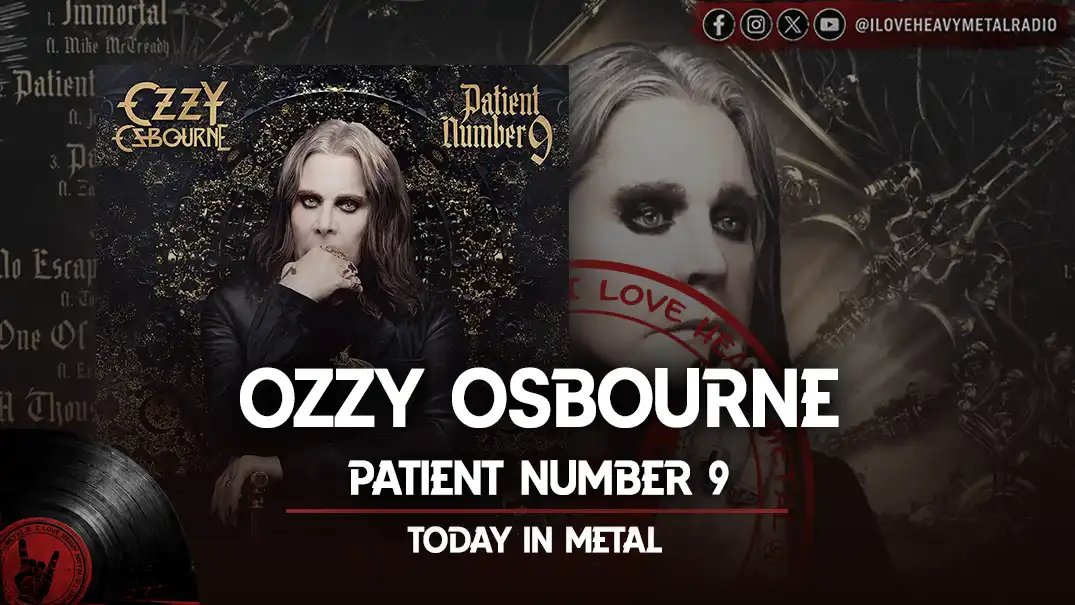

At 73, Ozzy Osbourne had absolutely nothing left to prove.
He had already been there. Done that. Changed heavy metal forever. Survived the madness, the drugs, the fame, the near-death moments, Black Sabbath, a legendary solo career and more than a few stories that probably shouldn’t be repeated in polite company.
And yet, on September 9th, 2022, the Prince of Darkness returned with another album.
Not a nostalgia cash-in.
Not a victory lap.
“Patient Number 9” sounded hungry.
Dark, heavy, bluesy and occasionally downright sinister, Ozzy 13th solo studio album became one of the biggest surprises of his later career and arguably his strongest record in more than 20 years.
And then there were the guitars.
Oh, those guitars.
Ozzy Built a Supergroup
One of the great pleasures of “Patient Number 9” is reading the credits and realizing just how ridiculous the guest list is.
Jeff Beck. Tony Iommi. Eric Clapton. Zakk Wylde. Mike McCready. Josh Homme.
That’s not an album lineup.
That’s a guitar-history convention.
And somehow, the record never feels like a collection of random celebrity cameos.
Each guitarist brings something different.
Zakk Wylde delivers the kind of muscular, unmistakably Ozzy guitar attack we’ve come to expect from him.
Jeff Beck brings something more unpredictable and expressive to the title track and “A Thousand Shades”.
Tony Iommi, naturally, brings the darkness home.
His appearance on “No Escape From Now” and “Degradation Rules” is particularly special because it reunites the two men who essentially invented heavy metal together.
When Iommi riff arrives, you don’t need to see his name in the credits.
You just know.
Then There’s “Patient Number 9”
The title track immediately establishes the album mood.
It’s catchy, but there’s something unsettling underneath it.
Ozzy sings about confinement, mental health and the feeling of being trapped inside your own mind. It’s deeply personal territory for an artist who has spent decades turning his own chaos into music.
And then Jeff Beck enters.
His guitar doesn’t simply provide a solo.
It feels like another voice inside the song.
That’s one of the album biggest strengths: the guest musicians aren’t there simply to show off.
They’re part of the atmosphere.
Tony Iommi Brings the Sabbath Darkness
If you grew up on Black Sabbath, hearing Ozzy and Iommi together again is impossible to ignore.
But “Patient Number 9” isn’t trying to recreate “Paranoid”.
Instead, “No Escape From Now” feels like a meeting between two eras.
Ozzy voice is older. The production is modern. The guitars are enormous.
But underneath it all is that familiar Sabbath darkness.
And “Degradation Rules” goes even further, combining Iommi filthy riffing with a bluesy harmonica and Ozzy sounding like he has absolutely no intention of behaving himself at 73.
It’s one of the album most fun moments.
A Voice That Refuses to Quit
There’s no pretending Ozzy sounds exactly like he did in 1980.
He doesn’t.
And why should he?
The man was in his seventies when he recorded the album, and his health struggles had become increasingly public.
Producer Andrew Watt used modern vocal production to help shape and smooth Ozzy performances. Some listeners loved the result. Others weren’t nearly as forgiving.
That’s probably the biggest criticism you’ll hear about “Patient Number 9”.
The production can be polished.
Sometimes very polished.
But underneath the studio treatment is still that voice.
That strange, instantly recognizable Ozzy delivery.
You could put one line of Ozzy on a song and know who it is before the second line arrives.
That’s something production can’t manufacture.
The Four-Day Taylor Hawkins Session
One of the album most bittersweet stories involves Taylor Hawkins.
The Foo Fighters drummer recorded his parts during an intense four-day studio session with Andrew Watt, bringing explosive energy to the songs he played on.
Hawkins contributed drums to tracks including “Parasite”, “Mr. Darkness” and “God Only Knows”.
He died in March 2022, just months before “Patient Number 9” was released.
Knowing that makes those performances hit differently.
What was originally another Ozzy studio session suddenly became part of Hawkins’ final musical legacy.
Ozzy Wanted Clapton to Use a Wah Pedal
And here’s one of those wonderfully Ozzy stories.
When Eric Clapton recorded his guitar part for “One of Those Days” Ozzy had a very specific request.
He wanted Clapton to use a wah-wah pedal.
Clapton wasn’t initially doing it.
Ozzy kept pushing Andrew Watt about it.
Watt eventually contacted Clapton engineer and when that still wasn’t enough, sent a wah-wah pedal directly to Clapton studio.
Clapton plugged it in.
Problem solved.
It’s a tiny detail, but it says something about Ozzy involvement in the record.
Even at this stage of his career, he knew what he wanted.
Ozzy’s Monsters Came to Life
The title-track video adds another bizarre chapter.
It was directed by Todd McFarlane, the legendary comic-book artist and creator of Spawn.
McFarlane didn’t simply invent a new Ozzy visual world.
He used Ozzy own drawings.
Ozzy has always been a prolific doodler, filling pages with strange creatures and dark figures. McFarlane took those hand-drawn monsters and had them animated for the video.
The result looks like Ozzy imagination escaped from the sketchbook.
And because apparently that wasn’t enough, the video also features footage of the famous bats flying beneath Austin’s Congress Avenue Bridge.
Real bats, real darkness, very Ozzy.
The Sabbath Reunion That Happened From Afar
There’s another fascinating detail hidden inside the album.
“Patient Number 9” marked the first time Tony Iommi appeared on an Ozzy solo album.
But the two Black Sabbath legends didn’t actually record together in the same room.
The pandemic made that impossible.
Instead, Ozzy and Andrew Watt worked remotely with Iommi in the UK, exchanging files digitally.
It’s a strange way for such a historic collaboration to happen.
But maybe there’s something fitting about it.
Two musicians who have been connected for more than half a century, still finding a way to create something heavy together, even when they’re separated by an ocean.
The Players Behind the Prince of Darkness
Although the guest list gets most of the attention, the core musicians deserve plenty of credit.
Andrew Watt was everywhere guitars, bass, keyboards, piano, drums and backing vocals in addition to producing the album.
Zakk Wylde supplied guitars and keyboards across much of the record.
Robert Trujillo returned to play bass on seven of the album 13 tracks.
Chad Smith handled much of the drum work.
Then came the guests.
Jeff Beck. Tony Iommi. Eric Clapton. Mike McCready. Josh Homme. Taylor Hawkins. Duff McKagan. Chris Chaney.
It’s an absurd collection of talent.
And yet “Patient Number 9” still sounds like an Ozzy Osbourne album.
That’s probably the greatest achievement.
Not Just Another Late-Career Ozzy Record
The easiest thing Ozzy could have done was make a safe album.
He didn’t.
“Patient Number 9” embraces his past while allowing modern production and a ridiculous cast of musicians to push it somewhere new.
It has Sabbath-like doom.
Blues-rock swagger.
Huge modern riffs.
Melodic hooks.
Dark lyrics.
And enough guitar firepower to make any metalhead stop what they’re doing and check the credits.
Sure, some songs could probably have been trimmed.
Sure, the vocal production won’t convince everyone.
But those criticisms almost become secondary when you consider what this album represents.
Ozzy Osbourne wasn’t simply trying to remind us that he used to be a legend.
He was showing that the legend was still capable of making noise.
The Verdict
“Patient Number 9” isn’t Ozzy “Blizzard of Ozz”.
It doesn’t need to be.
That album belongs to another lifetime.
Instead, this is an older, darker Ozzy looking directly at aging, mortality, mental health and everything that comes with surviving a life that should have destroyed him several times over.
And somehow, he turned all of that into another damn good metal record.
With Jeff Beck, Tony Iommi, Zakk Wylde, Taylor Hawkins, Eric Clapton…
With a whole army of legendary musicians.
But most importantly with Ozzy.
The Prince of Darkness wasn’t finished yet.
Not even close.
So, where does Patient Number 9 rank?
Ozzy best album of the 21st century or does the modern production keep it from reaching the classics?
And which guest guitarist stole the show?
🤘 Iommi, Beck, Wylde, Clapton, McCready or Homme?

 By
By
 By
By