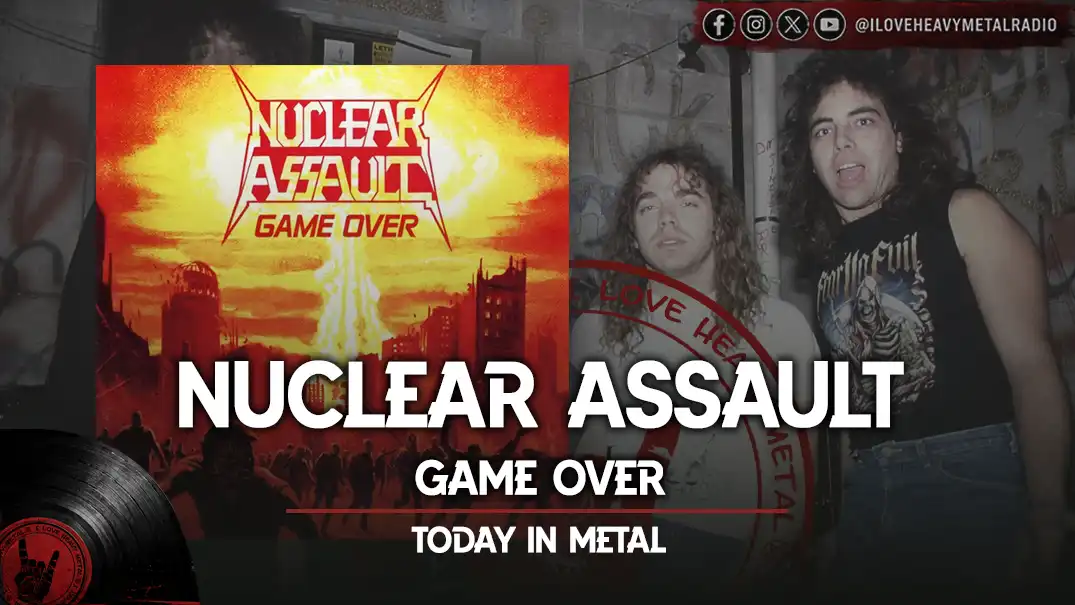

On October 7th, 1986, Nuclear Assault released “Game Over” a debut that wasted absolutely no time getting to the point.
Fast, raw and loaded with New York hardcore energy, the album fused crossover punk aggression with speed-metal riffing and cold-war apocalypse. Most of the songs hit hard and disappear before you’ve even caught your breath.
That was the point.
“Game Over” wasn’t trying to sound polished. It sounded dangerous.
Thrash With No Time to Waste
Nuclear Assault were formed in New York in 1984 by bassist Dan Lilker and vocalist/guitarist John Connelly after Lilker departure from Anthrax.
For “Game Over” the lineup was completed by lead guitarist Anthony Bramante and drummer Glenn Evans.
Together, they created a sound that sat right between thrash metal and hardcore punk aggressive, fast and unpredictable.
The album apocalyptic themes fit perfectly with the era. Nuclear war and destruction weren’t distant fantasy subjects; they were part of the atmosphere surrounding 1980s metal.
And Nuclear Assault turned that anxiety into speed.
46 Seconds of Chaos
Some thrash songs feel short.
“Hang the Pope” barely gives you time to register what happened.
At roughly 46 seconds, it’s a lightning-fast grind-punk explosion and one of the album most notorious tracks.
Then there’s “Mr. Softee Theme” an instrumental lasting only about 25 seconds, turning the familiar ice cream truck jingle into a ridiculously fast thrash-metal sprint.
Because apparently even the ice cream man wasn’t safe from Nuclear Assault.
But underneath all the speed, the album had plenty of memorable songwriting.
“After the Holocaust” became a fan favorite thanks to its catchy, high-energy attack, while “Nuclear War” slows things down slightly with a heavier, mid-paced approach and shifting tempos.
Then Comes “Brain Death”
After spending most of the album racing through two- and three-minute explosions Nuclear Assault suddenly change the rules.
The closing track “Brain Death” runs for around seven minutes.
It begins quietly with an acoustic introduction before gradually building into a punishing thrash assault.
That contrast makes the song stand out even more. Instead of ending with another short burst of speed “Game Over” closes with something much bigger an epic that gives the album room to breathe before crushing everything again.
The Cassette Had a Secret
There was also a little piece of “Game Over” that some listeners missed.
The original cassette version included a track called “Lesbians” which wasn’t included on the CD version.
The song didn’t disappear completely, though. Nuclear Assault later performed it on their 1992 live album Live at the Hammersmith Odeon.
It’s one of those small details that makes old metal releases so much fun to dig into.
Different formats could actually mean different music.
Ed Repka’s Apocalypse
The album visual identity was just as memorable as its sound.
The vibrant orange-and-yellow post-apocalyptic cover was created by legendary metal artist Ed Repka, whose artwork became closely associated with some of the most recognizable releases in metal.
The cover looks like the world has already ended.
The music sounds like Nuclear Assault are making sure there’s nothing left standing.
A Crossover Classic
“Game Over” was widely praised as an essential 1986 thrash debut, with reviews often highlighting its raw aggression and unusually audible bass.
Its reputation continued to grow long after its release. The album was ranked No. 287 in Rock Hard’s The 500 Greatest Rock & Metal Albums of All Time in 2005, and in 2017 it was inducted into the Decibel Magazine Hall of Fame.
That’s a pretty strong legacy for a debut built around songs that often barely last three minutes.
“Game Over” captured Nuclear Assault at their rawest fast enough for the thrash crowd, punk enough for the hardcore kids, and weird enough to make the album impossible to mistake for anyone else.
Crossover thrash classic or is Nuclear Assault later material stronger?

 By
By
 By
By
 By
By