
There are heavy metal albums that sound huge.
And then there’s “…And Justice for All”.
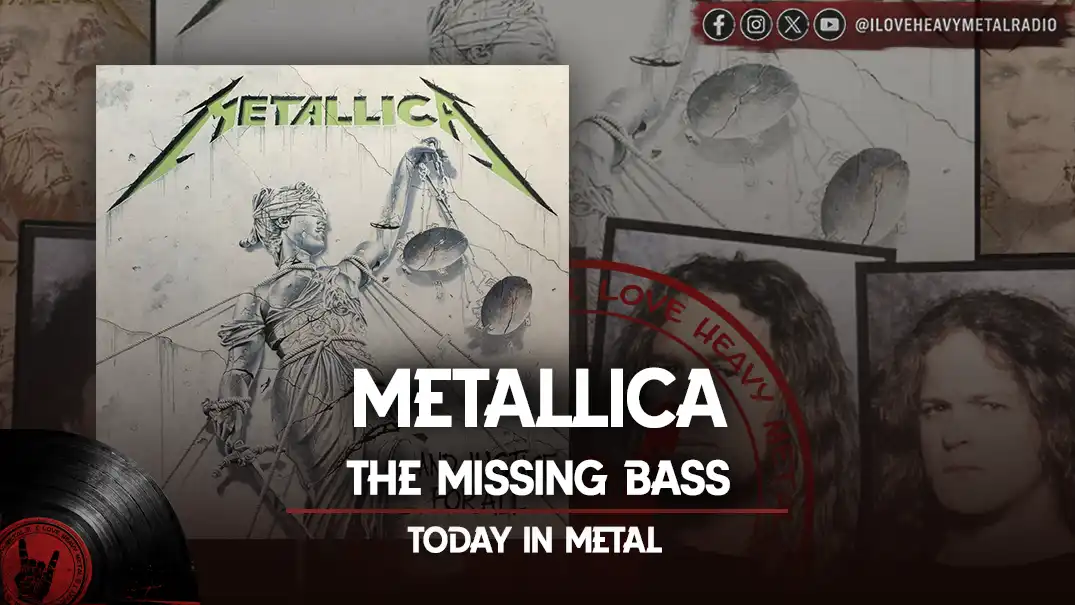
Released on September 7th, 1988, Metallica fourth studio album is one of the strangest masterpieces in metal history. Brutally technical, ridiculously ambitious, emotionally bleak and yes, it has the most famous missing bass guitar in rock.
But listen past the controversy and something remarkable emerges.
This was a band trying to figure out what Metallica could become after losing Cliff Burton.
Metallica Had Something to Prove
Cliff’s death in 1986 changed everything.
Jason Newsted stepped into one of the most impossible jobs in metal: replacing a bassist whose personality, playing and songwriting had become inseparable from Metallica identity.
Instead of making a straightforward follow-up to “Master of Puppets”, Metallica went completely the other way.
They made the songs longer, stranger and more complicated.
“Blackened” opens the album like a machine coming apart at full speed. James Hetfield rhythm guitar is relentless, Lars Ulrich drumming constantly shifts underneath it, and the riffs seem determined never to stay in one place for too long.
Then comes the title track.
Almost ten minutes of changing tempos, intricate riffs and musical twists.
This wasn’t music designed for casual listening.
Metallica wanted you to work for it.
And Then Came “One”
If there is one song that captures the entire album, it’s “One”.
It begins quietly, almost painfully, before gradually building into one of Metallica most devastating finales.
The lyrics tell the story of a soldier trapped inside his own body after being horribly wounded in war. By the time the guitars explode and Lars double bass starts firing underneath them, the song has transformed from a haunting ballad into an emotional assault.

And then Kirk Hammett delivers that solo.
The song earned Metallica their first Grammy nomination and helped introduce the band to a much larger audience.
But it also came with something their underground fans weren’t always comfortable with:
a music video.
The cinematic video used footage from Johnny Got His Gun and Metallica acquired the rights to the film so the footage could be used legally.
For a band that had built its reputation in the underground, MTV exposure was another line being crossed.
Some fans called it selling out.
Metallica just kept getting bigger.
The Bass That Almost Disappeared
Now we get to the elephant in the room.
Jason Newsted bass.
Or, more accurately, the lack of it.
On the finished album, the bass is famously buried so deeply that generations of metal fans have wondered what the hell happened.
According to mixing engineer Steve Thompson, Lars Ulrich insisted that the bass be turned down dramatically during mixing, with James Hetfield backing him.
Whatever the exact combination of reasons, the result is undeniable.
The album sounds cold, dry and strangely hollow.
For some listeners, that’s a production disaster.
For others, it’s part of the album’s personality.
There’s almost no warmth.
The guitars slice.
The drums click.
Everything feels tense.
And somehow, that bleak sonic character fits the lyrics perfectly.
Jason Newsted Wasn’t the Problem
It’s important to remember something.
Jason didn’t walk into the studio and play badly.
Quite the opposite.
He had to lock himself to Hetfield impossibly precise rhythm guitar work, often essentially doubling those parts on bass.
And he wasn’t simply a hired replacement.
Newsted received a co-writing credit on “Blackened”, contributing to the song massive opening riff.
Yet his presence was barely allowed to exist in the final mix.
For a young musician joining Metallica after Cliff Burton, that must have been one hell of a welcome.
Cliff Was Still There
Even though Cliff was gone, his shadow hangs over the entire record.
Nowhere is that more obvious than “To Live Is to Die”.
The largely instrumental track was built partly around musical ideas Burton had written before his death.
It feels like a memorial without needing to announce itself as one.
The music moves between beautiful melodic passages and crushing riffs before ending with words attributed to Burton.
It’s one of the album most haunting moments and one of the clearest reminders that Metallica were still carrying their loss into the studio.

Metallica Were Getting Weird
There’s a reason “…And Justice for All” still fascinates musicians.
The band practically abandoned the traditional verse-chorus formula.
Songs stretch out.
Riffs appear, disappear and return in altered forms.
Time signatures shift.
Sections collide.
Lars and James essentially built songs like giant puzzles, assembling fragments of riffs into sprawling compositions.
It’s progressive metal without Metallica ever really becoming a progressive metal band.
And James Hetfield?
This might be his ultimate rhythm-guitar showcase.
His down-picking, precision and ability to keep those ridiculous riffs locked in remain legendary among guitarists.
But Was It Too Much?
Probably.
That’s part of the album charm and its biggest weakness.
At nearly 66 minutes “…And Justice for All” can feel exhausting.
The songs demand attention. The production can be harsh. Some arrangements feel like they could have lost a few minutes without losing their impact.
But maybe that’s exactly why the album remains so addictive.
It doesn’t spoon-feed you.
Every return to the record reveals another riff, another transition, another little detail buried inside the madness.
The Grammy That Got Away
Metallica were widely expected to win the first Grammy for Best Hard Rock/Metal Performance in 1989.
They didn’t.
The award went to Jethro Tull.
Yes.
Jethro Tull.
For a metal category.
The backlash was so enormous that when Metallica finally won three years later for the “Black Album” James Hetfield famously thanked Jethro Tull for not releasing an album that year.
Metal history doesn’t get much more entertaining than that.
The Beginning of the End of the Old Metallica
In retrospect, “…And Justice for All” feels like the final moment before Metallica changed forever.
The ambition was still enormous.
The riffs were still vicious.
The band was still willing to make songs that demanded patience.
But the next step would be different.
The “Black Album” arrived in 1991 and stripped away much of this complexity in favor of groove, space, melody and massive accessibility.
Suddenly, Metallica belonged to everyone.
But “…And Justice for All” belongs to a different Metallica.
A hungrier one.
A more frustrated one.
A band still carrying Cliff absence while simultaneously trying to prove that they could survive without him.
And perhaps that’s why the album’s imperfections make it more interesting not less.
The missing bass.
The endless riffs.
The strange production.
The 10-minute songs.
The tension that hangs over the entire record.
It’s not perfect.
It’s Metallica at their most uncompromising.
And sometimes, that’s far more interesting.
Final Verdict
“…And Justice for All” isn’t the easiest Metallica album to love.
But once it gets under your skin, it’s incredibly difficult to escape.
A cold, complex, furious monument to a band that refused to slow down after tragedy.
Masterpiece or one of metal most overrated albums?
And be honest…
Could you ever forgive them for burying Jason bass? 🤘🔥

 By
By
 By
By
 By
By