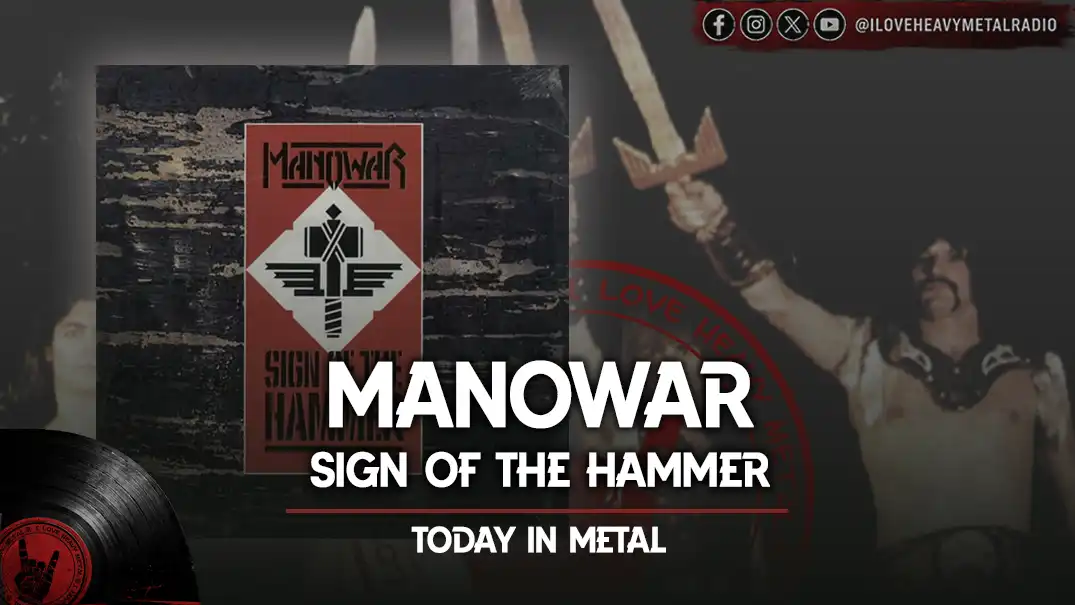

Manowar never wanted to sound like everybody else. They wanted to sound bigger, heavier, louder and on October 15th, 1984 they gave the metal world another reason to raise a fist.
“Sign of the Hammer” was the band’s fourth studio album, packed with thunderous bass, powerful vocals, and the kind of heavy metal attitude that didn’t care about fitting in. It also had Norse gods, dark history, and an eight-minute song about one of the most horrifying tragedies of the 20th century.
But the story behind this album is almost as wild as the music.
Two Albums, One Big Gamble
Some of the songs on “Sign of the Hammer” came from the same recording sessions as “Hail to England”, which the band worked on at Phase One Studios in Toronto between 1983 and the winter of 1984.
According to guitarist Ross “The Boss” Friedman, Manowar recorded enough material to build two albums out of those sessions. The band had been working with a limited budget and the extra tracks helped them secure a new deal with 10 Records, a subsidiary of Virgin Records.
There was one more problem, though. The label wanted another song for the album.
Joey DeMaio quickly wrote “Sign of the Hammer” and the band travelled to Manor Studios in Oxford, England, to record it. The title track became one of the album defining moments and gave Manowar a name for the gesture that fans would carry around the world.
The Sign That United the Army of Immortals
Cross one wrist over the other and clench your fists. Metal fans know the gesture, but “Sign of the Hammer” helped make it part of Manowar identity.
The idea reportedly came from road manager Paul Clark, who wanted fans to have a way to recognize one another without saying a word.
It became a symbol for Manowar loyal fanbase, known as the Army of Immortals. Few bands have built such a recognizable connection with their fans and this album helped give that connection a name and a sign.
Of course, the music had to live up to the gesture.
Thor, Mountains, and a Darker Side of Manowar
“Thor (The Powerhead)” brings Norse mythology into the band world of epic heavy metal. Written by DeMaio, it tells of Thor destroying the evils of the world, with the kind of larger-than-life subject matter that would return throughout Manowar career.
But the album doesn’t stay in the world of gods and legends.
“Guyana (Cult of the Damned)” takes on the 1978 Jonestown mass suicide led by Jim Jones. The eight-minute closing epic is a dark and disturbing change of direction, with Eric Adams opening the song with the chilling line “Thank you for the Kool-Aid, Reverend Jim”.
It’s a long way from fantasy warriors and Norse gods. Manowar turned a real-life tragedy into a dramatic metal story and Adams delivers it with theatrical intensity.
Then there’s “Mountains” where DeMaio uses a piccolo bass to create an eerie, almost guitar-like melody. It’s a good example of how the album could explore different sounds while keeping the bass right at the centre of the music.
All Men Play on 10 – But Did Manowar Go Too Far?
“All Men Play on 10” became one of the album best-known tracks, celebrating the band loud-and-proud metal attitude. “Animals” brought another side of the record, with a sound some critics compared to glam metal an interesting contrast for a band so determined to defend what it considered true metal.
Critics didn’t agree on everything. Some praised Ross “The Boss” Friedman guitar work and the album strongest songs, while others felt the production sounded flat or the songwriting was uneven. Still, the record has remained an important part of Manowar catalogue and was ranked No. 418 in Rock Hard’s The 500 Greatest Rock & Metal Albums of All Time in 2005.
Even the physical releases became part of its story. Some cassette editions reportedly swapped the two sides, Scott Columbus name appeared as “Scutt” on an inlay and a later compilation printed the title as “Sign of the Hammer”.
Not exactly the kind of immortal legacy the band had in mind but certainly memorable.
Forty Years Later, the Hammer Still Falls
Manowar announced plans for a re-recorded version of “Sign of the Hammer” for its 40th anniversary in 2024. DeMaio later said the release was delayed because the initial sessions didn’t meet the band power standards, leading them to rethink their studio setup.
That sounds very Manowar: if it’s not heavy enough, go back and make it heavier.
Featuring Eric Adams, Ross “The Boss” Friedman, Joey DeMaio and Scott Columbus, “Sign of the Hammer” remains a record full of contrasts fantasy and real horror, speed and atmosphere, raw power and unusual musical ideas.
Is “Sign of the Hammer” one of Manowar greatest albums or does “Hail to England” still wear the crown?

 By
By