
When Maiden Refused to Play It Safe
By 2015 Iron Maiden had absolutely nothing left to prove.
They had conquered stadiums, survived lineup changes, released genre-defining albums and built a catalog most bands would kill for.
So what did they do next?
They made a 92-minute double album.
Because apparently, making things easy was never really Maiden style.
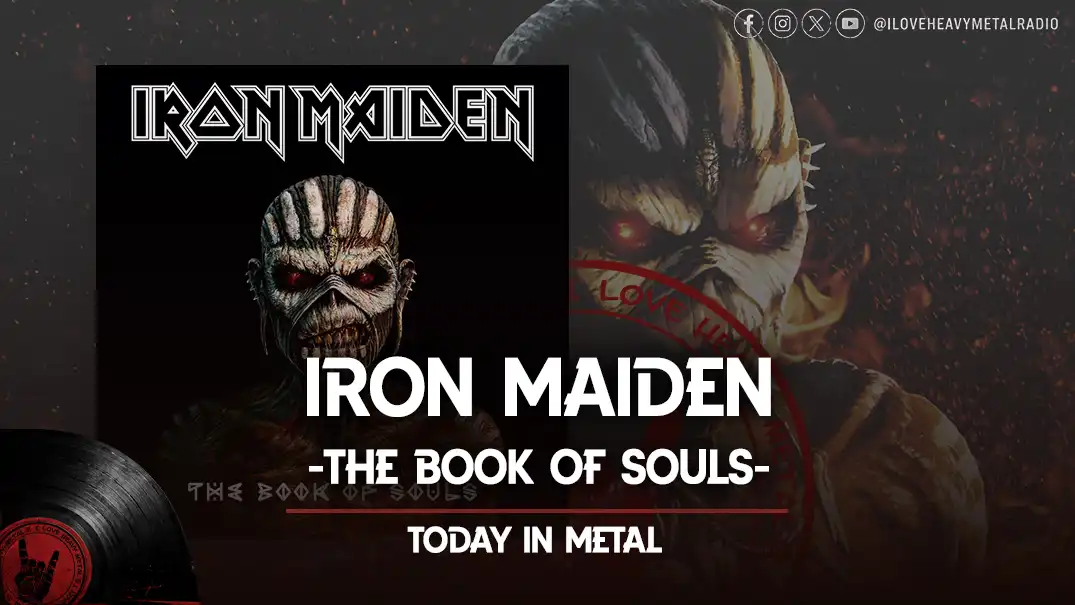
Released on September 4th, 2015, “The Book of Souls” became the band 16th studio album and their biggest musical gamble in years. Eleven tracks, sprawling arrangements, progressive twists, three-guitar firepower and enough epic storytelling to fill an entire evening.
And somehow, it didn’t feel like a band desperately trying to sound relevant.
It sounded like Iron Maiden doing whatever the hell they wanted.
Maiden Went Big. Really Big.
Right from “If Eternity Should Fail” the album feels cinematic and mysterious. Bruce Dickinson dramatic vocals rise over a huge instrumental backdrop before Maiden launches into classic heavy metal territory.

Then comes “Speed of Light”! Shorter, faster and immediately familiar. It’s almost a reminder that yes, Maiden can still write a straight-up metal banger when they feel like it.
But “The Book of Souls” isn’t really interested in staying there.
“The Red and the Black” stretches out with Steve Harris trademark songwriting, massive sing-along moments and those glorious three-guitar harmonies that make Maiden sound like Maiden.
And then there’s “Empire of the Clouds”.
Oh, boy.
18 Minutes of Madness
An 18-minute song about the 1930 R101 airship disaster sounds like the sort of idea that should have been rejected in the first meeting.
Instead, Bruce Dickinson turned it into the longest song Iron Maiden had ever recorded.
And here’s the really cool part: Bruce played piano on it.
He wasn’t a professional pianist. He had actually taught himself after winning a keyboard in a raffle.
During the recording sessions in Paris, he reportedly spent weeks working through the piano parts, recording them painstakingly in sections. While Maiden were tearing through riffs in the main studio, Bruce was essentially locked away in a soundproof booth figuring out the arrangement.
That’s not exactly your average heavy metal recording session.
The Album Was Made Under Pressure
There’s another reason “The Book of Souls” has such a lively feel.
A lot of the songs weren’t endlessly polished before recording. Steve Harris revealed that many were written and then recorded almost immediately.
Adrian Smith described the pressure as something that snapped the band into action.
You can hear it.
There’s an organic quality to the album. The bass is huge, the guitars are bright and alive, and the performances don’t feel surgically cleaned up.
It sounds like a band playing together.
And Then There’s Eddie…
For the artwork, Eddie got a Mayan makeover, perfectly matching the album mysterious atmosphere.
The attention to detail even went beyond the artwork itself. Maiden brought in a Mayan scholar to help translate the song titles into authentic hieroglyphics for the booklet.
Because when you’re Iron Maiden apparently even the liner notes need archaeological research.

A Record With Something to Say
Not everything is epic mythology and historical disaster.
“Tears of a Clown” written by Adrian Smith and Steve Harris was inspired by the death of comedian Robin Williams.
It’s one of the album more emotional moments and another example of Maiden using their music to explore something beyond the usual metal fantasy.
Then there’s Bruce.
This album arrived after his battle with cancer treatment and his performance makes the achievement even more remarkable. Rather than sounding cautious, he sounds hungry.
Vital.
Dramatic.
Like someone who had been given another chance to stand behind that microphone and wasn’t going to waste a second of it.
Too Long?
Here’s where Maiden fans start fighting.
Because yes, 92 minutes is a lot of Iron Maiden.
Some listeners love every sprawling second. Others think the album could have lost a few minutes and become stronger.
And “Empire of the Clouds” remains particularly divisive. For some fans, it’s an ambitious masterpiece and one of Maiden greatest late-career achievements. For others, 18 minutes is simply too much of a good thing.
But maybe that’s what makes “The Book of Souls” interesting.
It wasn’t designed to be safe, it wasn’t designed to recreate “Powerslave” or “Seventh Son of a Seventh Son”.
It was a veteran band saying:
We’ve been doing this for decades. We’re still curious. Let’s see how far we can take it.
A Number-One Maiden Moment
The risk paid off.
“The Book of Souls” reached No. 1 in 24 countries and peaked at No. 4 on the Billboard 200 in the United States.
It also marked the end of an era: the album was Maiden first release through Parlophone Records, ending their legendary 30-year relationship with EMI.
But the biggest achievement wasn’t the chart position.
It was the fact that, more than three decades into their career, Iron Maiden could still release an enormous, ambitious album and have metalheads arguing passionately about it.
That’s a pretty good problem to have.
The Maiden Question
Be honest:
Is “The Book of Souls” a late-career masterpiece or would you cut a few songs and make it a killer single album?
And where does “Empire of the Clouds” rank for you?
UP THE IRONS! 🤘

 By
By
 By
By
 By
By