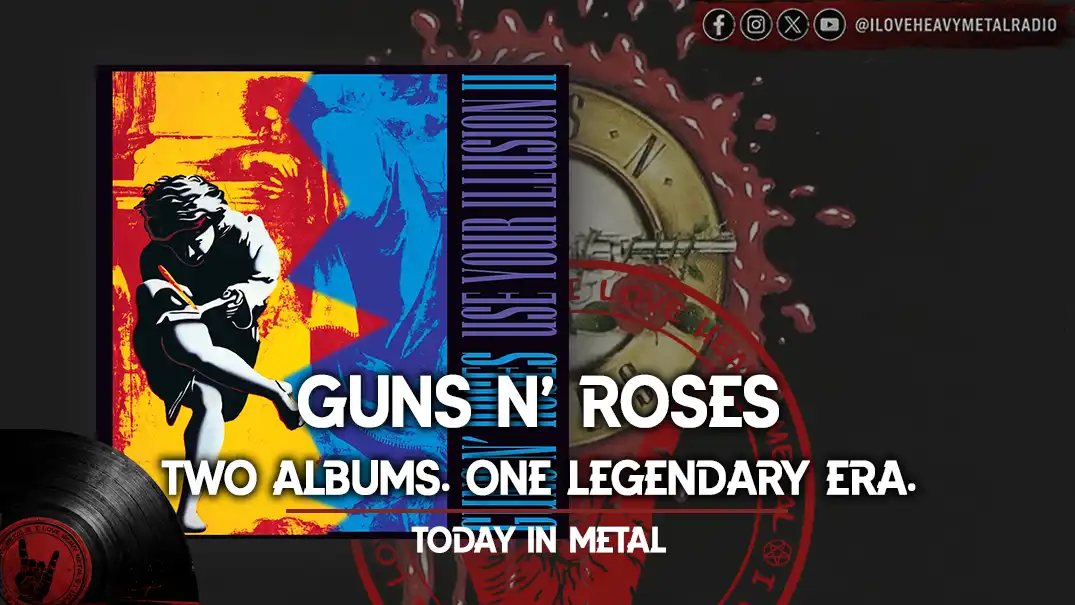

On September 17th, 1991, Guns N’ Roses didn’t release one album. They released two.
Use Your Illusion I and Use Your Illusion II arrived on the same day giving fans more than 30 tracks and over two and a half hours of music. It was completely excessive and that was exactly the point.
Guns N’ Roses were at the absolute peak of their fame, but instead of simply making another Appetite for Destruction, they went bigger. Much bigger.
Piano. Orchestras. Horns. Synths. Acoustic passages. Nine-minute ballads. Ten-minute epics. Covers. Political songs. Pure hard-rock attitude.
And somehow, the whole thing became one of the defining moments of ’90s rock.
Two Albums. Two Spots.
The gamble paid off immediately.
Use Your Illusion II debuted at No. 1 on the Billboard 200, while Use Your Illusion I landed at No. 2.
Guns N’ Roses had just taken the top two spots with two albums released on the same day.
The band had gone from the dangerous street-rock attitude of Appetite for Destruction to something far more ambitious without completely losing the swagger that made them huge in the first place.
Use Your Illusion I
Volume I contains some of the band most recognizable songs.
“November Rain” became the monster of the collection: nearly nine minutes of piano, orchestra and Slash unforgettable guitar solos. It wasn’t exactly the kind of song you’d expect from the band behind “Welcome to the Jungle”.
And that’s what made it work.
“Don’t Cry” brought another emotional side of Axl Rose, while “Live and Let Die” turned the Paul McCartney & Wings classic into a full-blown Guns N’ Roses assault.
Then comes “Coma”.
At 10 minutes and 14 seconds, it remains the longest song in the Guns N’ Roses catalog. The sprawling track follows a descent into and recovery from a medical coma, drawing from real-life overdose experiences involving Axl Rose and Slash.
It’s messy, intense and completely unapologetic.
Basically, Guns N’ Roses doing Guns N’ Roses with absolutely no interest in keeping things short.
Use Your Illusion II
If Volume I had “November Rain” Volume II had “Estranged”.
Another nine-minute journey, it combines piano, huge guitars and deeply vulnerable lyrics with one of the band most iconic music videos.
Then there’s “You Could Be Mine” a furious, precision-driven track that found another life as the main theme of Terminator 2: Judgment Day.
“Civil War” went in a different direction, using marching rhythms, acoustic and electric guitars and spoken-word samples to deliver an anti-war message.
And “Knockin’ on Heaven’s Door” transformed Bob Dylan classic into a massive stadium anthem that became a Guns N’ Roses live staple.
Two albums. Two completely different moods.
And somehow, they belonged together.
The Videos Became Events
The music wasn’t the only thing that became enormous.
“Don’t Cry”, “November Rain” and “Estranged” formed a cinematic trilogy that helped turn Guns N’ Roses music videos into major productions rather than simple clips for television.
The videos were expensive, dramatic and completely over the top exactly what you’d expect from a band operating at the height of its powers.
The twin album covers followed the same idea, using artist Mark Kostabi colorful reinterpretation of a detail from Raphael “The School of Athens”.
Even the artwork looked like these were supposed to be more than ordinary rock albums.
Behind the Madness
The recording sessions produced some seriously strange stories.
The bizarre industrial closer “My World” was reportedly written and recorded in only three hours. Axl Rose later claimed the room was high on mushrooms after a friend slipped the drug into his tea.
Then there’s “Get in the Ring”.
It sounds like a completely chaotic live performance, but the track was actually recorded in the studio, with crowd noise added from a real concert in Saratoga Springs, New York.
And the band wasn’t exactly making things easy for retailers either.
Walmart and Kmart refused to stock the physical albums because of the profanity. The band response was essentially to suggest that offended shoppers visit the stores’ new age section instead.
Very Guns N’ Roses.
Steven Adler’s Final Contribution
The albums also marked a major lineup transition.
Original drummer Steven Adler had been fired during the early stages of production because of his heroin addiction. His final studio contribution to Guns N’ Roses appears on “Civil War”.
The drum track reportedly had to be assembled from roughly 60 separate takes.
Matt Sorum took over on drums, while Dizzy Reed became the band first official keyboardist, helping expand the band sound considerably.
And there was another major change coming.
These would be the final studio albums featuring founding guitarist Izzy Stradlin, who left during the subsequent tour. Gilby Clarke later stepped in on rhythm guitar for the Use Your Illusion World Tour.
The End of One Era
There’s something almost symbolic about Use Your Illusion I and II.
They captured Guns N’ Roses at the moment when everything had become enormous the music, the videos, the tours, the expectations and the internal chaos.
The albums could be aggressive one minute and heartbreaking the next.
They could sound like a bar fight, a stadium singalong or a Hollywood movie soundtrack.
And that’s exactly why they remain so fascinating.
Maybe there are too many songs.
Maybe some of the ballads go too far.
Maybe the band should have cut the filler and made one absolutely killer album.
Or maybe that would completely miss the point.
Because Use Your Illusion was never about restraint.
It was about Guns N’ Roses having the biggest stage in rock and deciding to use every inch of it.
So let’s settle this one:
If you could keep only one Use Your Illusion I or Use Your Illusion II which one are you taking? 🤘

 By
By
 By
By

 By
By