
Some metal albums are heavy. Some are dark.
And then there are albums that sound like the end of the world has been given a symphony orchestra.
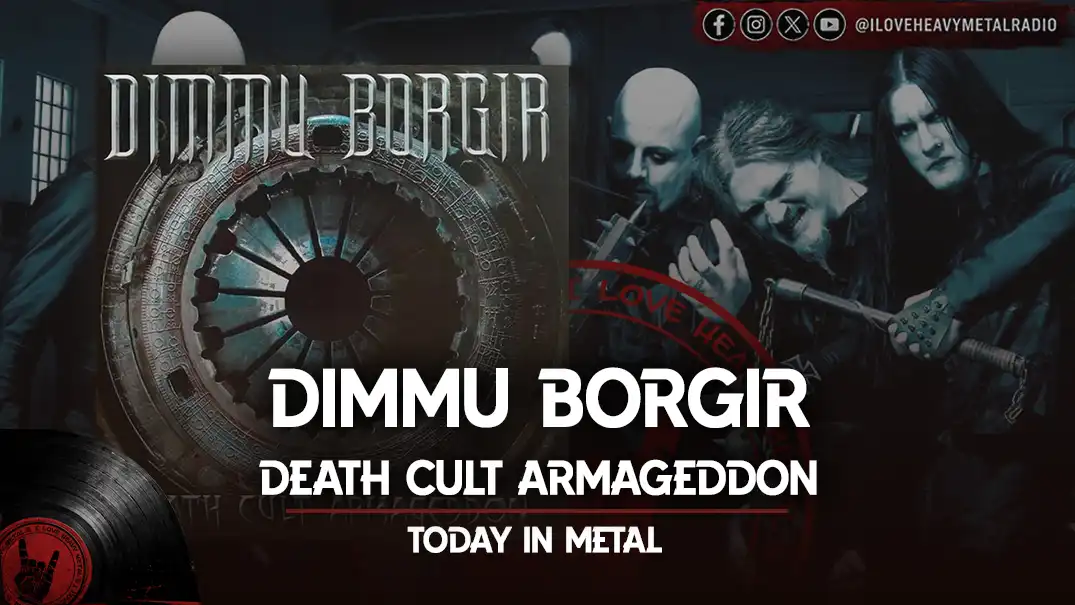
Released on September 8th, 2003, Dimmu Borgir’s “Death Cult Armageddon” was exactly that.
The Norwegian band had already built a reputation for pushing black metal into increasingly ambitious territory, but this album took the idea of symphonic black metal and practically threw it into a Hollywood blockbuster. Huge orchestration, savage blast beats, razor-sharp guitars and Shagrath unmistakable screams collided into something that sounded less like a traditional black metal record and more like the soundtrack to an apocalyptic war.
And somehow, it worked.
Black Metal Gets Cinematic
By 2003, Dimmu Borgir were no longer interested in keeping their music small.
“Death Cult Armageddon” was recorded with an enormous sense of scale, featuring the Prague Philharmonic Orchestra and roughly 46–52 classical musicians. This wasn’t simply an orchestra sitting quietly behind the guitars.
The symphonic arrangements became part of the songs themselves.
Strings, brass, piano and choir-like textures constantly rise and fall around the riffs, creating an atmosphere that can feel grand, sinister and almost theatrical.
The result was one of the most ambitious records extreme metal had heard at the time.
It also marked the first time Dimmu Borgir incorporated a full brass and horn section into their sound.
This was black metal but black metal with a blockbuster budget.
“Progenies of the Great Apocalypse” Was the Moment
If “Death Cult Armageddon” has one song that perfectly explains its entire existence, it’s “Progenies of the Great Apocalypse”.
The piano.
The orchestra.
The blast beats.
The crushing guitars.
And then those dramatic clean vocals from ICS Vortex cutting through Shagrath vicious rasp.
It’s ridiculously theatrical and that’s precisely why it works.
The song became one of Dimmu Borgir signature tracks and helped introduce the band to listeners far beyond the traditional black metal audience.
The Hollywood connection came soon enough.
“Progenies” appeared in the trailer for Hellboy, giving the band one of those surreal moments every musician dreams about. Silenoz later recalled sitting in a movie theater in Texas when his own music suddenly blasted from the speakers.
Imagine hearing your own black metal band in a Hollywood trailer while sitting in a cinema.
Pretty metal.
Then the Orchestra Takes Over
The brilliance of “Death Cult Armageddon” isn’t simply that Dimmu Borgir used a real orchestra.
It’s how they used it.
On “Eradication Instincts Defined” the orchestration creates an almost twisted classical opening before the track explodes into double-bass thunder and extreme-metal violence.
“Vredesbyrd” takes a different route, combining Norwegian-language vocals with fast, aggressive black metal and dramatic symphonic layers.
“Allegiance” comes out swinging, driven by a memorable groove that immediately establishes the album apocalyptic mood.
And then there’s “Heavenly Perverse” a relentless riff machine that also features guest vocals from none other than Abbath of Immortal.
Because apparently regular black metal wasn’t evil enough.
The Golden-Era Lineup
The lineup behind this record reads like a who’s-who of early-2000s extreme metal.
Shagrath handled the vocals, delivering the theatrical rasp and darker growls that became synonymous with the band sound.
Silenoz, co-founder and primary lyricist, provided much of the crushing rhythm-guitar foundation.
Galder brought sharp, melodic and technically precise lead guitar work.
ICS Vortex handled bass while adding those towering clean vocals that gave songs like “Progenies” another dimension.
Mustis was crucial to the band elaborate keyboard and orchestral arrangements.
And behind the drum kit was Nicholas Barker.
Fast.
Precise.
Absolutely relentless.
“Death Cult Armageddon” would become Barker final studio album with Dimmu Borgir, making his performance here even more significant in retrospect.
The Album That Took Dimmu Borgir Mainstream
For some black metal purists, the sheer polish of “Death Cult Armageddon” was a problem.
The underground had always been associated with rawness, dirt and atmosphere. Dimmu Borgir were heading in the opposite direction.
Everything was bigger.
Cleaner.
More precise.
More cinematic.
And commercially, it paid off.
“Death Cult Armageddon” became the band breakthrough to a much wider audience and was notably the first Nuclear Blast release to surpass 100,000 sales in the United States.
That kind of success was unusual for an extreme-metal record.
Naturally, not everyone was impressed.
Some critics jokingly referred to Dimmu Borgir as the “ABBA of black metal” because of their huge crossover appeal and polished presentation.
But here’s the thing:
You don’t have to like the direction Dimmu Borgir took to deny what they accomplished.
They made symphonic black metal sound enormous.
Black Metal Meets Hollywood
The album cinematic personality didn’t stop with Hellboy.
Orchestral passages from “Death Cult Armageddon” also found their way into trailers and television, while the band music appeared in video games including Brütal Legend.
Suddenly, Dimmu Borgir music wasn’t confined to metal clubs and record collections.
It was everywhere.
And “Progenies of the Great Apocalypse” became one of those songs that could instantly make a room feel like something terrible was about to happen.
That’s a pretty good achievement for a black metal band.
But Is It Still Black Metal?
That’s the debate that has followed “Death Cult Armageddon” for more than two decades.
For one side, this is the perfect evolution of symphonic black metal a record that takes the genre darkness and aggression and gives it an enormous musical vocabulary.
For the other, the production is too clean, the orchestra too dominant and the songwriting too polished to capture the dangerous spirit of classic black metal.
Both arguments have some truth.
But listen to the album with the volume turned up.
The guitars still bite.
The drums still destroy.
Shagrath still sounds like he’s announcing the apocalypse from the gates of hell.
And the orchestra doesn’t make the riffs less heavy.
It makes them feel massive.
The Legacy of Death Cult Armageddon
More than 20 years later “Death Cult Armageddon” remains one of the defining albums of symphonic extreme metal.
It showed that black metal could become cinematic without completely abandoning its aggression. It proved that a real orchestra could be more than decoration. And it helped bring a previously underground sound to a much larger audience.
Was it too polished?
Maybe.
Was it too ambitious?
Absolutely not.
Because that’s what makes the album so fascinating.
Dimmu Borgir didn’t try to make “Death Cult Armageddon” sound like another black metal record.
They tried to make it sound like the apocalypse.
And they came surprisingly close.
So, masterpiece or overblown symphonic madness?
That’s where the argument starts.
Is “Death Cult Armageddon” Dimmu Borgir masterpiece or did the Hollywood sized production take too much of the black metal out of black metal?
And more importantly…
What’s your favorite track? 🤘

 By
By
 By
By
 By
By