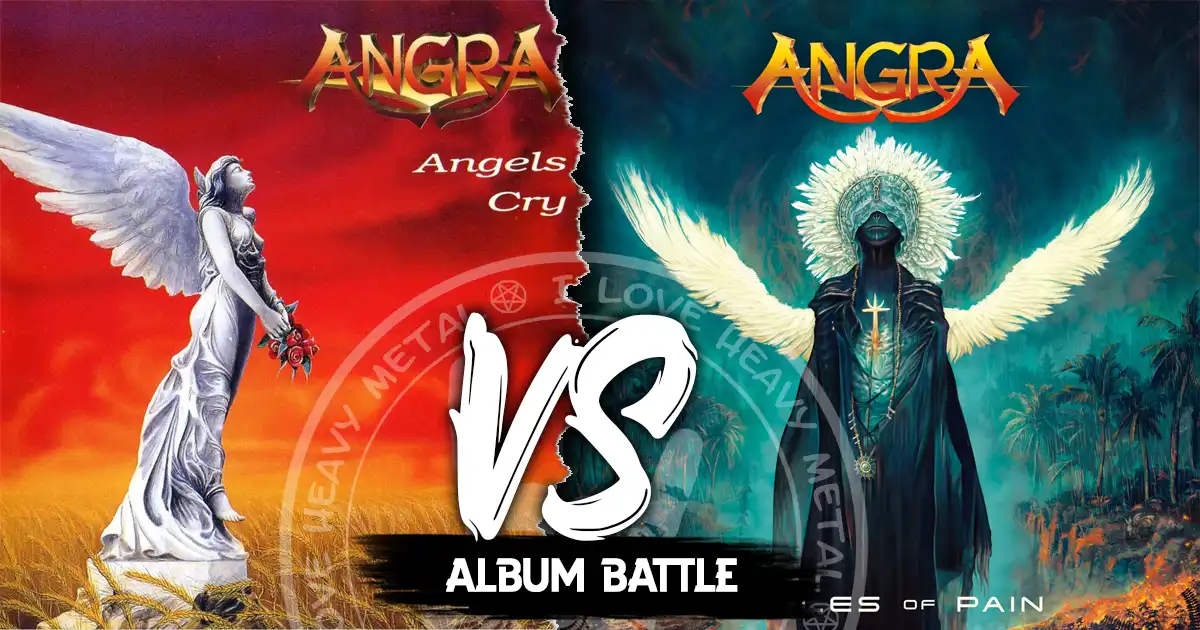

Some bands change a lot over the years, and Angra is a good example. Their debut album “Angels Cry” came out in 1993 and helped put Brazilian power metal on the map. Thirty years later, they released “Cycles of Pain”, showing another side of the band’s sound while keeping plenty of the things that made Angra special.
Both albums have their own character. One introduced the world to the band’s mix of fast metal and classical influences, while the other brought together progressive power metal, Brazilian rhythms and more personal themes. So, let’s put these two Angra records against each other.
“Angels Cry” (1993)
Released on November 3, 1993, “Angels Cry” was Angra’s debut album, and it made quite an entrance. Recorded in Hamburg, Germany, it brought together fast power metal, progressive ideas and classical music influences. You can hear the inspiration of composers like Paganini and Vivaldi, but this is still a metal album first.
The record featured the late André Matos on vocals, along with guitarists Kiko Loureiro and Rafael Bittencourt, bassist Luís Mariutti and session drummer Alex Holzwarth. Sascha Paeth handled production and orchestral programming.
And what a collection of songs it gave us. “Carry On” is the big one, with its speed, high notes and dramatic changes. The opening classical passage, “Unfinished Allegro”, even quotes Schubert’s “Unfinished Symphony”. The title track brings orchestral parts and a guitar solo inspired by Paganini’s 24th Caprice.
There is more to discover beyond those two songs. “Wuthering Heights” takes on Kate Bush’s classic with André Matos showing just how far he could push his voice. “Evil Warning” is another fast fan favorite, while “Time” mixes technical playing with a strong melody.
“Never Understand” adds Brazilian folk rhythms and some interesting changes, with guest guitar solos from Kai Hansen and Dirk Schlächter. And then there is “Lasting Child”, a two-part track that moves from darker, emotional moments to a much more uplifting finish.
For a debut, “Angels Cry” had a lot going on. It was fast, melodic, ambitious and full of ideas. And it still sounds like a band with something to prove.
“Cycles of Pain” (2023)
Thirty years after that debut, Angra released “Cycles of Pain”, on same day November 3, 2023, through Atomic Fire Records. The lineup was Fabio Lione on vocals, Rafael Bittencourt and Marcelo Barbosa on guitars, Felipe Andreoli on bass and Bruno Valverde on drums.
The album keeps Angra’s progressive power metal roots but brings in more symphonic passages, neoclassical touches and Brazilian and Latin rhythms. Dennis Ward handled the engineering, while several guest artists added their own colors to the record.
Title track is a good clue to what this album is about. Is a songs deal with suffering, depression, anxiety, loss, disillusionment and recovery. It is a more personal subject than the fantasy and adventure often found in power metal.
“Ride Into the Storm” gets things moving with fast guitars, orchestration and a soaring choir. “Dead Man on Display” brings a heavier, high-speed attack, while “Gods of the World” takes a more progressive route with an intricate instrumental opening and technical guitar work.
The title track slows things down with an emotional ballad, showing a different side of the band. “Generation Warriors” brings back the fast, melodic power metal spirit, while “Vida Seca” stands out with Brazilian-inspired rhythms and guest vocals from Lenine.
There is also “Faithless Sanctuary”, where Bruno Valverde’s Brazilian-rooted percussion gives the song a different rhythmic feel. Guest appearances from Amanda Somerville, Vanessa Moreno and pianist Juliana D’Agostini add even more variety to the album.
“Cycles of Pain” doesn’t try to recreate the sound of the band’s early years. It takes the Angra formula in another direction, with different voices, different experiences and plenty of musical detail.
The Battle: Which Angra Album Wins?
This is not an easy choice. “Angels Cry” has the magic of a debut, André Matos’s unforgettable vocals and songs like “Carry On” that became part of power metal history. “Cycles of Pain” shows how much Angra has grown, with a more modern sound and a wider range of musical influences.
One takes us back to the beginning. The other shows where the band was thirty years later.
If you could keep only one Angra album, which would it be: “Angels Cry” or “Cycles of Pain”?

 By
 By

 By