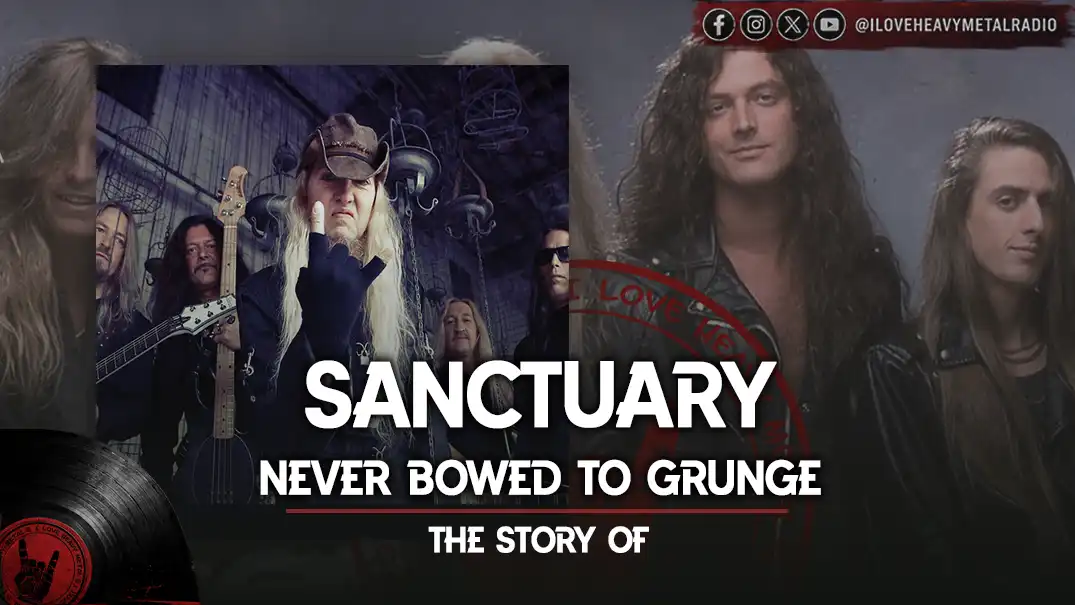

Before Seattle became synonymous with grunge, there was already a serious metal scene growing in the city. Sanctuary were right in the middle of it loud, ambitious, dramatic and determined to sound like themselves.
Formed in Seattle in 1985 by cousins and guitarists Lenny Rutledge and Sean Blosl, Sanctuary started out playing covers alongside their own material. Then Warrel Dane entered the picture and things changed quickly. Once Dane joined, the band left the covers behind and focused entirely on original songs.
And somehow, a demo tape ended up in Dave Mustaine hotel room.
A Demo, Dave Mustaine and a Record Deal
After hearing Sanctuary demo, Mustaine was impressed enough to promise to produce the band. Sanctuary soon played support shows with Megadeth and Mustaine produced their debut album “Refuge Denied”.
The connection didn’t stop there. Megadeth manager Keith Rawls also took on Sanctuary and helped secure the band a deal with Epic Records. “Refuge Denied” was released in 1988 after being remixed by the label, putting Sanctuary on a much bigger stage.
The album also opened the door to serious touring. Sanctuary shared stages with Megadeth, Warlock, Savatage, Testament, Nuclear Assault, Fates Warning, Vio-lence, Flotsam and Jetsam, Meliah Rage, Forced Entry and others.
Oh, and Mustaine also contributed a guitar solo to Sanctuary cover of Jefferson Airplane’s “White Rabbit”.
Not exactly a bad start.
Warrel Dane Was Anything But Ordinary
A huge part of Sanctuary identity was Warrel Dane.
Dane voice could go from dark and heavy to an almost unbelievable high register, helped by five years of opera training. He was known for an enormous five-octave range and Sanctuary music gave him plenty of room to use it.
There is even a great story behind how he joined the band.
Rutledge and Blosl had heard that Dane had left his previous project Serpent’s Knight and wanted him in Sanctuary. Their solution? Write a song specifically to get his attention. They called it “Wally’s Song”.
It worked.
Once Dane was in the band Sanctuary stopped playing covers for good.
His personality also went far beyond the stage. Before music took over, Dane worked as a professional chef and he and bassist Jim Sheppard even co-owned an Italian restaurant in Seattle.
Then there was the unmistakable Dane voice showing up in a completely different place: Adult Swim’s Metalocalypse, where he voiced the character Candynose Twinskins.
Into the Mirror Black: Sanctuary at Full Power
Sanctuary followed “Refuge Denied” with “Into the Mirror Black” in 1990.
The album pushed the band further and the video for “Future Tense” even received airplay on MTV’s Headbangers Ball. The touring lineup also grew more interesting, with Jeff Loomis joining after Sean Blosl left.
For a moment, Sanctuary looked like a band ready to carve out a much bigger place for itself.
Then Seattle changed.
Grunge was exploding, and Epic Records wanted Sanctuary to change direction along with it. The pressure to move toward the new Seattle sound created disagreements inside the band over where their music should go.
Sanctuary chose not to abandon the metal that made them who they were.
In 1992, the band disbanded.
But Sanctuary Left Something Behind
The split didn’t mean the end of the story.
Warrel Dane, Jim Sheppard and Jeff Loomis went on to form Nevermore, creating another important chapter in Seattle metal history. Lenny Rutledge continued working as a producer and even helped Nevermore during demo sessions.
Sanctuary themselves were gone but not forgotten.
Their influence remained part of a Seattle scene that also produced bands such as Queensrÿche, Metal Church, Fifth Angel, TKO, Culprit, Rail, Forced Entry, Q5, Mother Love Bone, Alice in Chains and Soundgarden.
And the Sanctuary story still had another chapter waiting.
The Reunion
In 2010, four founding members Dane, Sheppard, Rutledge and Dave Budbill came together for a few reunion performances.
Those few shows were supposed to be just that.
Instead, the response was strong enough and the chemistry on stage good enough, to convince them to reunite permanently.
The comeback eventually led to a new deal with Century Media and, in 2014, “The Year the Sun Died”.
It wasn’t simply an attempt to recreate the past. Dane himself made it clear that Sanctuary weren’t going to sound exactly like their earlier records. The songs were heavier, the vocals still carried those trademark screams, but the band had changed with time.
And that was the point.
Sanctuary were coming back as Sanctuary in 2014 not pretending it was 1990 again.
The Darker Side of Sanctuary
Some of the band stories sound almost supernatural.
While recording “Into the Mirror Black”, Jim Sheppard recalled waking up around 3:00 AM and finding Dane writing lyrics in complete darkness. Dane said he was channeling words from his late father for the haunting song “Epitaph”.
Years later, Sanctuary video for “Frozen” was filmed inside an abandoned factory building in Germany with its own dark history.
It all fits the atmosphere of a band whose music has always carried something mysterious and theatrical.
Losing Warrel Dane
On December 13, 2017, Warrel Dane died of a heart attack in São Paulo, Brazil, while recording his second solo album.
For a band so closely identified with its singer, continuing without him could never be simple.
Sanctuary did, however, choose to move forward.
In 2018, Joseph Michael of Witherfall stepped in for the North American tribute tour with Iced Earth. The response was strong and Michael and Rutledge began working on demos with the possibility of continuing Sanctuary.
That possibility eventually became a new era.
Sanctuary Today
Lenny Rutledge and Dave Budbill remain part of Sanctuary, with George Hernandez on bass and Joseph Michael on vocals. Will Wallner is also touring with the band on lead guitar.
And Sanctuary are still making new music.
With 2026’s “Not of the Living”, the band has entered another chapter rather than simply living in the shadow of its past.
There is something fitting about that.
Sanctuary spent their first era refusing to follow where the Seattle scene was going. They disappeared, returned almost two decades later, lost the voice that defined them, and still found a way forward.
That is more than a comeback story.
It is the story of a metal band that refused to bend.
And maybe that is exactly why Sanctuary still matters.

 By
By
 By
By